
Facebook Ads Lifecycle: 5 Critical Stages from Testing to Re-Scaling (Complete Growth Framework)
Master the 5-stage Facebook Ads lifecycle: Testing, Scaling, Stabilization, Refinement, and Re-Scaling. Learn systematic approaches for each phase to grow from $500 to $50k/day profitably.
TL;DR: Facebook Ads success isn't about random tactics—it's about systematic lifecycle management. Every ad account moves through 5 distinct stages: (1) Testing (finding what works), (2) Scaling (rapid expansion), (3) Stabilization (building consistency), (4) Refinement (optimizing efficiency), and (5) Re-Scaling (breaking through plateaus). Each stage requires different strategies, metrics, and mindsets. Master this framework to grow from hundreds to tens of thousands per day while maintaining profitability.
---Why Most Facebook Advertisers Fail: They Don't Understand Lifecycle Stages
Many advertisers treat Facebook Ads as a simple on/off switch or bid adjustment game. They apply the same tactics whether they're spending $100 or $10,000 per day.
The reality: A Facebook ad account is a living system that evolves through distinct lifecycle stages—from chaos to order, from testing to maturity, from discovery to optimization.
Understanding which stage you're in determines:
- What to optimize (creative vs. audience vs. budget vs. structure)
- What metrics matter (CTR vs. CPA vs. ROAS vs. stability)
- What risks to take (aggressive testing vs. conservative scaling)
- What team skills you need (creative testing vs. data analysis vs. operational excellence)
Today, we'll break down the 5 critical lifecycle stages of Facebook Ads and the specific playbook for each.
---Stage 1: Testing Phase — Finding Your Breakthrough
Duration: 2–3 months
Budget Range: $500–$2,000/day
Primary Goal: Discover winning creative-audience combinations
Key Metric: CTR, Initial CVR, Creative Performance
The Core Challenge
New advertisers make a fatal mistake: trying to do everything at once. They want:
- Great creatives
- Perfect audiences
- Low CPC
- High conversions
- Immediate ROI
This "everything at once" approach creates noisy data where you can't tell what's actually working.
The Testing Framework
Rule #1: One Primary Goal Per Campaign
Each test campaign should have ONE clear objective:
- Creative test: Same audience, multiple creative variations
- Audience test: Same creative, multiple audience segments
- Product test: Same setup, different product offers
Structure for Creative Testing (1-1-4 or 1-4-4):
- Lock audience, placement, and geography
- Vary only the creative concept
- Test 4–6 variations per batch
- Budget: $20–$50 per creative per day
Structure for Audience Testing (1-4-1):
- Same creative across 4 distinct audiences
- Equal budget allocation (ABO)
- Test: Interests vs. Lookalikes vs. Broad vs. Retargeting
Testing Phase Guardrails
Keep:
- CTR ≥ 1.0%
- CVR ≥ category baseline
- CPA within 1.5× of target
Watch (1–2 more days):
- CTR 0.7–1.0%
- Some conversions but inconsistent
- CPA slightly above target
Kill:
- CTR < 0.7% after $100 spend
- Zero conversions after $150 spend
- CPA > 2× target with no improvement trend
What Success Looks Like
After 2–3 months of disciplined testing:
- 3–5 winning creatives with consistent CTR > 1.5%
- 2–3 profitable audience segments with stable CPA
- Clear understanding of what messaging resonates
- ROI ≥ 2.0 on best-performing campaigns
- Repeatable process for launching new tests
Stage 2: Scaling Phase — Rapid Expansion
Duration: 1–3 months
Budget Range: $2,000–$10,000/day
Primary Goal: Maximize volume while maintaining profitability
Key Metric: Daily spend growth, ROAS stability, volume
The Scaling Mindset
In the scaling phase, speed matters more than perfect efficiency. Your goal is to capture market share before competitors do.
This doesn't mean reckless spending—it means accepting controlled chaos in exchange for rapid growth.
Three Scaling Levers
1. Vertical Scaling (Budget Increases)
The 20–30% Rule:
- Increase winning campaign budgets by 20–30% every 2–3 days
- Never double budgets overnight (causes delivery shock)
- Monitor for 48 hours after each increase
Example progression:
- Day 1: $500
- Day 3: $650 (+30%)
- Day 6: $845 (+30%)
- Day 9: $1,100 (+30%)
- Day 12: $1,430 (+30%)
2. Horizontal Scaling (Duplication)
Duplicate winning campaigns at the same budget:
- Creates parallel delivery lanes
- Reduces risk of budget shock
- Allows faster volume growth
When to duplicate:
- Campaign ROAS ≥ 2.5 for 3+ days
- CPA stable within target
- No signs of audience saturation
3. Expansion Scaling (New Audiences)
Lookalike ladder:
- Start: 1% LAL of purchasers
- Expand: 2% LAL → 3% LAL → 5% LAL
- Test: Stacked LALs (1–3%, 1–5%)
Geographic expansion:
- Tier 1: US, UK, CA, AU
- Tier 2: DE, FR, IT, ES, NL
- Tier 3: Emerging markets (based on product fit)
Demographic expansion:
- Age brackets: 25–34 → 35–44 → 45–54
- Gender: If starting male-only, test female audiences
- Device: Mobile-first → Desktop → Tablet
Scaling Phase Guardrails
Proceed if:
- ROAS ≥ 2.0 (minimum)
- CPA within target margin
- Daily conversion volume increasing
- Creative frequency < 2.5
Pause if:
- CPA spikes > 50% after budget increase
- ROAS drops below 1.5 for 2+ days
- Creative frequency > 3.5
- Conversion rate declining
Real-World Example: Black Friday Scaling
Normal daily budget: $2,000–$5,000
BFCM daily budget: $30,000–$50,000
Duration: 5–7 days
Preparation: 2 weeks of creative stockpiling
The approach:
- Pre-test 20+ creatives at low budgets
- Identify top 5 performers
- On BFCM: Launch 10 campaigns × $3,000 each
- Monitor hourly, kill underperformers, feed winners
- Accept 20–30% efficiency drop for 3–5× volume
Stage 3: Stabilization Phase — Building Consistency
Duration: Ongoing (2–4 months to establish)
Budget Range: $5,000–$20,000/day
Primary Goal: Predictable, repeatable performance
Key Metric: Consistency (daily ROAS variance), creative refresh rate
The Stabilization Challenge
After aggressive scaling, accounts often become chaotic:
- Too many campaigns
- Unclear naming conventions
- Duplicate audiences
- Fatigued creatives
- Unpredictable daily performance
Stabilization means building systems and processes that deliver consistent results.
The Creative Refresh System
Why it matters: Creative fatigue is the #1 killer of stable performance.
The 3–5 Creative Rule:
- Launch 3–5 new creatives every week
- Rotate out bottom 20% performers
- Maintain a creative library of 20+ tested assets
Creative types to rotate:
- Product-focused: Features, benefits, use cases
- Lifestyle: Product in real-world scenarios
- UGC: Customer testimonials, reviews, unboxing
- Offer-driven: Discounts, bundles, limited-time deals
- Educational: How-to, problem-solution, comparisons
Campaign Consolidation
Before stabilization:
- 50 campaigns, random budgets, unclear goals
After stabilization:
- 10–15 core campaigns with clear roles:
- 3 retargeting campaigns (different funnel stages)
- 2 testing campaigns (new creatives/audiences)
- 2–3 seasonal/promotional campaigns
Naming Convention Standard
Format: [Funnel]-[Geo]-[Audience]-[Creative]-[Date]
Examples:
PROS-US-LAL1-UGC-2026-02-04RETAR-UK-ATC-OFFER-2026-02-04TEST-CA-BROAD-LIFESTYLE-2026-02-04
Stabilization Metrics
Track daily:
- ROAS variance (target: < 15% day-to-day)
- CPA variance (target: < 20% day-to-day)
- Creative frequency (target: < 2.5)
- Campaign count (target: consolidate to 10–15 core)
Track weekly:
- New creatives launched (target: 3–5)
- Creative win rate (target: > 20%)
- Audience overlap (target: < 30%)
- Budget allocation (target: 50% prospecting, 30% retargeting, 20% testing)
Stage 4: Refinement Phase — Maximizing Efficiency
Duration: Ongoing (after stabilization)
Budget Range: $10,000–$50,000+/day
Primary Goal: Squeeze maximum profit from existing volume
Key Metric: Profit margin, LTV:CAC ratio, granular CPA by segment
When to Enter Refinement
Signals you're ready:
- Stable daily performance (ROAS variance < 15%)
- Mature pixel (10,000+ conversions)
- Clear understanding of customer LTV
- Market share captured (diminishing returns on scaling)
Refinement Tactics
1. Campaign Structure Optimization
Split by performance:
- High-ROAS campaigns: Increase budget, protect from changes
- Medium-ROAS campaigns: Test optimizations
- Low-ROAS campaigns: Kill or restructure
Split by funnel stage:
- TOF (Top of Funnel): Broad audiences, awareness content
- MOF (Middle of Funnel): Engaged audiences, consideration content
- BOF (Bottom of Funnel): High-intent audiences, conversion content
2. Placement Optimization
Analyze performance by placement:
- Facebook Feed vs. Instagram Feed vs. Stories vs. Reels
- Mobile vs. Desktop
- In-stream video vs. Search results
Action:
- Exclude bottom 20% placements
- Create placement-specific creatives
- Adjust bids by placement performance
3. Geographic Refinement
Country-level analysis:
- CPA by country
- ROAS by country
- LTV by country
Actions:
- Separate campaigns for top 3 countries
- Adjust bids by country performance
- Exclude countries with CPA > 2× target
4. Landing Page Optimization
Test variations:
- Headlines (benefit-driven vs. feature-driven)
- Hero images (product vs. lifestyle vs. social proof)
- CTA placement (above fold vs. below fold)
- Form length (short vs. long)
- Trust signals (reviews, guarantees, certifications)
Impact: 10–30% CVR improvement = 10–30% CPA reduction
5. Bid Strategy Refinement
Test bid caps:
- Start with automatic bidding
- Analyze actual CPAs
- Set bid caps at 1.2× target CPA
- Monitor delivery volume
Cost cap vs. Bid cap:
- Cost cap: Better for stable CPA, may limit volume
- Bid cap: More control, requires active management
Stage 5: Re-Scaling Phase — Breaking Through Plateaus
Duration: 1–2 months per breakthrough
Budget Range: Varies (often requires stepping back to scale forward)
Primary Goal: Find new growth vectors when current approach plateaus
Key Metric: New audience discovery, creative breakthrough, channel expansion
When You Need Re-Scaling
Plateau signals:
- Spend has been flat for 30+ days
- ROAS declining despite optimizations
- Creative win rate dropping (< 10%)
- Audience saturation (frequency > 3.5)
- Market share captured
Re-Scaling Strategy 1: New Creative Angles
The problem: Your current creative messaging has saturated your audience.
The solution: Shift the narrative framework.
From Product-Focused to Outcome-Focused
Before: "Our laser engraver has 5W power and 0.01mm precision"
After: "How a side-hustle mom built a $10k/month Etsy shop with one machine"
Framework shift:
- Product features → Life transformation
- Technical specs → Emotional outcomes
- What it does → What you become
From Individual to Team/Community
Before: Individual productivity tool
After: Team collaboration solution
Example:
- B2C angle: "Manage your personal projects efficiently"
- B2B angle: "How agencies deliver 3× more client reports without hiring"
When to use: When individual market is saturated, test team/business angles
From Direct Response to Content-First
Before: "Buy now, 50% off!"
After: Educational content → Soft CTA
Example:
- Old: Product image + discount code
- New: "5 mistakes killing your Facebook ROAS (and how to fix them)" → Free guide → Product mention
Re-Scaling Strategy 2: Audience Expansion
Lookalike Stacking
Standard: 1% LAL of purchasers
Advanced: Stacked LALs of multiple signals
Test:
- 1% LAL of purchasers + 1% LAL of high-value customers
- 1% LAL of email subscribers + 1% LAL of website visitors
- 1–3% LAL (broader but still warm)
Interest Expansion
If you've been running:
- Narrow interests (e.g., "Facebook Ads")
Test:
- Adjacent interests (e.g., "Digital Marketing", "E-commerce")
- Broader interests (e.g., "Entrepreneurship", "Small Business")
- Behavior-based (e.g., "Online shoppers", "Tech early adopters")
Broad Targeting
The shift: Remove all targeting, let Meta's algorithm find your audience.
When it works:
- Mature pixel (10,000+ conversions)
- Strong creative (CTR > 1.5%)
- Clear conversion signal
- Budget > $500/day per campaign
Re-Scaling Strategy 3: Channel Diversification
Beyond Facebook Feed:
- Instagram Reels: Short-form video content
- Facebook Stories: Vertical, immersive format
- Messenger: Direct conversation campaigns
- Audience Network: Extended reach
Omnichannel approach:
- Facebook/Instagram: Awareness + conversion
- Google Ads: Intent-based search
- TikTok: Younger demographics, viral potential
- Email/SMS: Owned audience, high ROI
Re-Scaling Strategy 4: Offer Innovation
When creative and audience are maxed out, change the offer structure.
Test:
- Bundles: "Buy 2, get 1 free" vs. single product
- Subscriptions: One-time purchase → Monthly subscription
- Upsells: Core product + premium add-on
- Financing: "Pay in 4 installments" (Klarna, Afterpay)
- Guarantees: "60-day money-back guarantee"
The Lifecycle Framework in Practice
Example: E-commerce Brand Journey
Month 1–3 (Testing):
- Budget: $500–$1,000/day
- Tested 30 creatives, found 5 winners
- Tested 10 audiences, found 3 profitable
- ROI: 1.5–2.0
Month 4–6 (Scaling):
- Budget: $2,000–$8,000/day
- Scaled winning combinations
- Expanded to 3 countries
- ROI: 2.0–2.5
Month 7–10 (Stabilization):
- Budget: $8,000–$12,000/day
- Built creative refresh system (5 new creatives/week)
- Consolidated to 12 core campaigns
- ROI: 2.5 (stable)
Month 11–14 (Refinement):
- Budget: $12,000–$15,000/day
- Optimized placements, landing pages, bids
- Improved CVR by 25%
- ROI: 3.0
Month 15+ (Re-Scaling):
- Budget: $15,000 → $25,000/day
- Launched new creative angle (lifestyle vs. product)
- Expanded to broad targeting
- Added Instagram Reels
- ROI: 2.8 (slight dip, but 60% volume increase)
Common Mistakes at Each Stage
Testing Phase Mistakes
❌ Testing too many variables at once
✅ One primary goal per campaign
❌ Killing tests too early (< $100 spend)
✅ Give each test fair budget ($150–$200)
❌ No clear success criteria
✅ Define CTR, CVR, CPA thresholds upfront
Scaling Phase Mistakes
❌ Doubling budgets overnight
✅ 20–30% increases every 2–3 days
❌ Scaling losing campaigns hoping they'll improve
✅ Only scale proven winners (ROAS ≥ 2.5)
❌ Ignoring creative fatigue
✅ Monitor frequency, refresh at 2.5+
Stabilization Phase Mistakes
❌ Too many campaigns, no clear structure
✅ Consolidate to 10–15 core campaigns
❌ No creative refresh system
✅ 3–5 new creatives every week
❌ Reactive optimization (panic mode)
✅ Systematic weekly reviews
Refinement Phase Mistakes
❌ Over-optimizing, killing volume
✅ Balance efficiency with scale
❌ Ignoring landing page CVR
✅ Test landing pages, 10–30% CPA improvement
❌ No segmentation (treating all traffic equally)
✅ Segment by country, placement, device
Re-Scaling Phase Mistakes
❌ Doing more of what's not working
✅ Fundamental shift: new angles, audiences, offers
❌ Abandoning what works
✅ Keep core campaigns, test new approaches in parallel
❌ Impatience (expecting instant results)
✅ Re-scaling takes 1–2 months to show results
---The Meta-Lesson: Systems Over Tactics
Facebook Ads is a system, not a collection of tactics.
Your system includes:
- Testing framework: How you discover what works
- Scaling process: How you grow profitably
- Creative pipeline: How you avoid fatigue
- Data infrastructure: How you measure and decide
- Team roles: Who does what, when
The best advertisers don't have secret tactics. They have better systems.
They know:
- Which stage they're in
- What metrics matter for that stage
- What actions to take (and not take)
- When to shift to the next stage
Your Action Plan
If you're in Testing Phase:
1. Simplify: One goal per campaign
2. Document: Track what you test and results
3. Patience: Give tests 2–3 months before scaling
If you're in Scaling Phase:
1. Budget discipline: 20–30% increases only
2. Duplication: Parallel campaigns for volume
3. Monitoring: Daily checks, 48-hour observation after changes
If you're in Stabilization Phase:
1. Creative system: 3–5 new creatives/week
2. Campaign cleanup: Consolidate to 10–15 core
3. Naming convention: Standardize for clarity
If you're in Refinement Phase:
1. Segmentation: Analyze by country, placement, device
2. Landing pages: Test variations, improve CVR
3. Bid strategy: Test cost caps, bid caps
If you're in Re-Scaling Phase:
1. New angles: Shift creative narrative
2. Audience expansion: Broad targeting, new LALs
3. Offer innovation: Bundles, subscriptions, financing
---Final Word: The Lifecycle Never Ends
Facebook Ads is not a "set it and forget it" channel. It's a living system that requires continuous evolution.
The lifecycle is circular:
- You'll re-enter testing when launching new products
- You'll re-scale when hitting plateaus
- You'll refine continuously as markets shift
The winners are those who:
- Recognize which stage they're in
- Apply the right playbook for that stage
- Build systems that outlast tactics
Master the lifecycle, and you'll scale profitably—not just once, but repeatedly, across products, markets, and years.
---Related Resources
Want to track performance across all lifecycle stages? Try Adfynx for Free — AI-powered Facebook Ads analytics that adapts to your growth stage.
Looking for testing frameworks? Check out How to Test Facebook Ads on a Tiny Budget to start your testing phase right.
Need scaling strategies? Read our guide on Facebook Ads Account Structure for Scaling to build systems that support growth.
Struggling with creative fatigue? Learn about Facebook Ad Creative Strategies to keep your campaigns fresh.
Want to understand Meta's algorithm? Explore Meta Andromeda Algorithm Complete Guide to optimize for each lifecycle stage.
You May Also Like
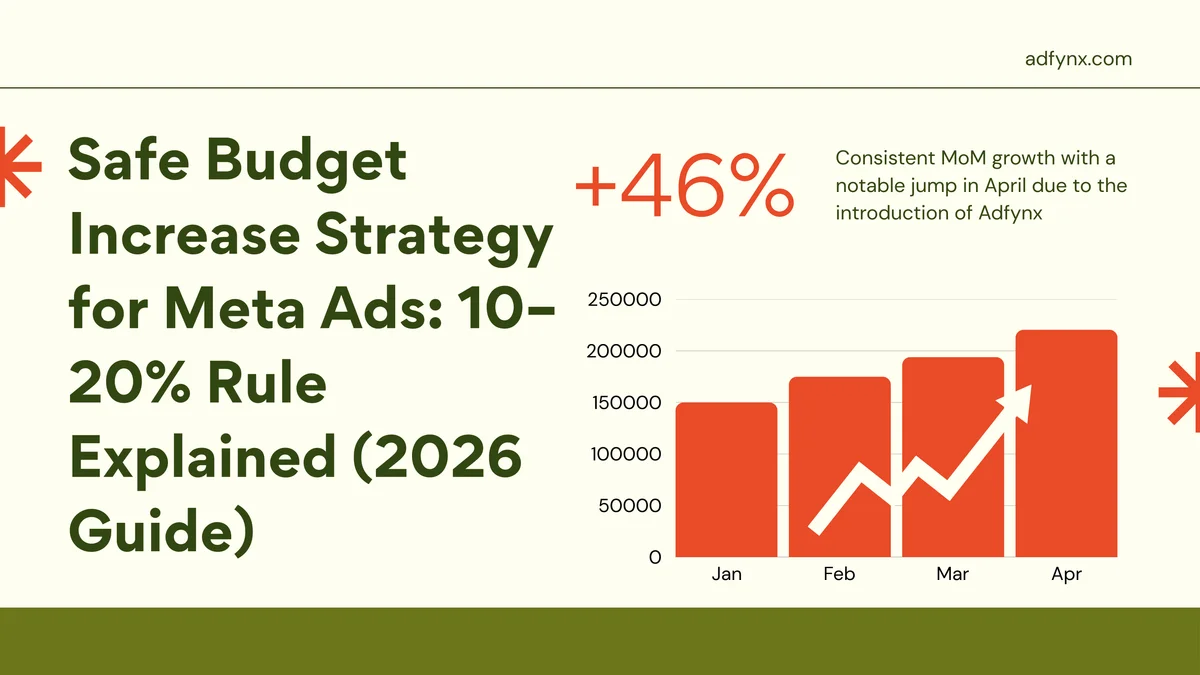
Safe Budget Increase Strategy for Meta Ads: 10–20% Rule Explained (2026 Guide)
Master safe Meta ads budget scaling with the proven 10-20% daily increase rule. Learn optimal timing (target region midnight), threshold limits (20% safe, 30-50% aggressive, >50% triggers learning reset), vertical vs horizontal scaling approaches, and when to break the rule for breakthrough scaling with broad targeting strategies.
Meta Ads Budget Distribution Explained: CBO vs ABO Strategy Guide for 2026
Master Meta ads budget distribution with the complete CBO vs ABO comparison. Learn when to use Campaign Budget Optimization (algorithmic distribution, 3-4 ad sets for small budgets, 7-10 for large) vs Ad Set Budget Optimization (manual control, testing scenarios), optimal ad set quantities by budget level, and why the 20% scaling rule is obsolete in 2026's AI-driven algorithm.
Why ROAS Drops When Scaling Meta Ads: 5 Root Causes and Proven Solutions for 2026
Discover why your Meta ads ROAS crashes from 3.0+ to under 1.0 when scaling budget, and learn the proven 3-part framework to scale profitably: gradual budget increases (10-20% increments), audience expansion strategies (LAL progression, broad targeting), and creative rotation systems that maintain performance at scale.
Subscribe to Our Newsletter
Get weekly AI-powered Meta Ads insights and actionable tips
We respect your privacy. Unsubscribe at any time.