
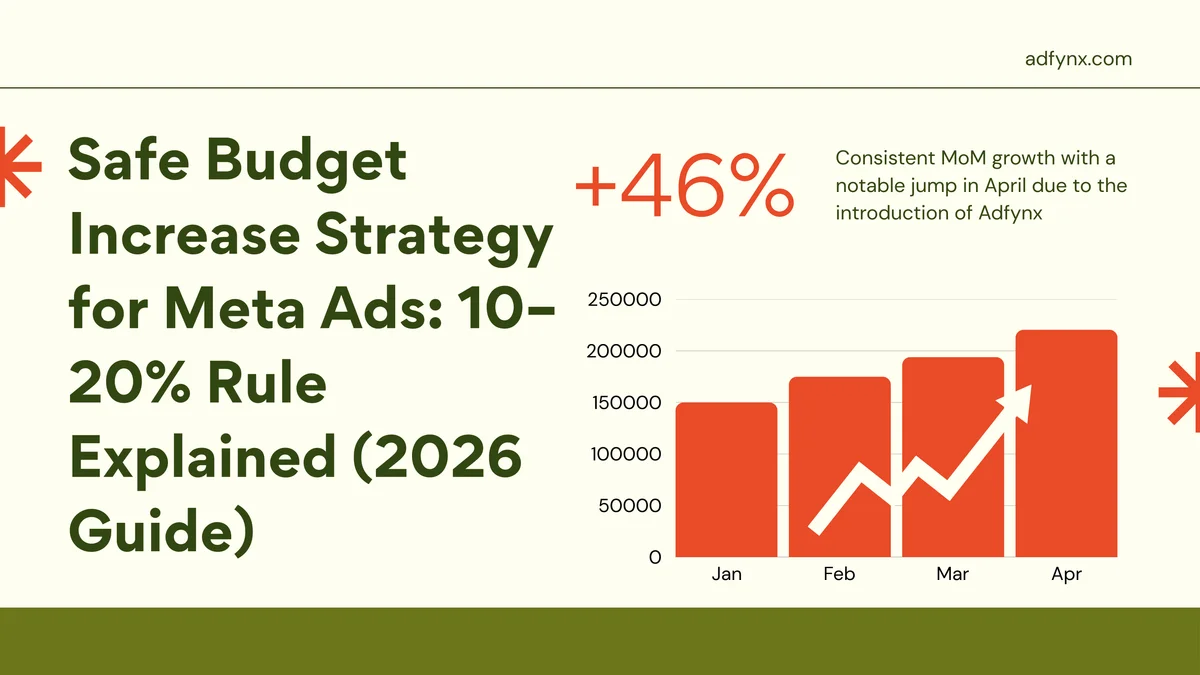
Safe Budget Increase Strategy for Meta Ads: 10–20% Rule Explained (2026 Guide)
Master safe Meta ads budget scaling with the proven 10-20% daily increase rule. Learn optimal timing (target region midnight), threshold limits (20% safe, 30-50% aggressive, >50% triggers learning reset), vertical vs horizontal scaling approaches, and when to break the rule for breakthrough scaling with broad targeting strategies.
# Safe Budget Increase Strategy for Meta Ads: 10–20% Rule Explained (2026 Guide)
Meta advertisers consistently encounter the same scaling paradox: campaigns performing profitably at small budgets ($50-$100/day) collapse when budget increases attempt to capture larger conversion volumes. The core challenge lies in Meta's learning phase sensitivity—aggressive budget modifications trigger algorithm resets that eliminate accumulated optimization data, causing CPA increases of 40-80% and ROAS declines that make scaled campaigns unprofitable.
The 10–20% daily budget increase rule emerged as the industry-standard safe scaling methodology because it remains below Meta's "significant edit" threshold that triggers learning phase resets. However, this conservative approach creates tension between risk mitigation and growth velocity: 20% daily increases require 12+ days to double budget, potentially missing seasonal opportunities or competitive advantages. Understanding when to apply conservative scaling, when to implement aggressive increases, and when to abandon incremental scaling entirely for breakthrough strategies determines scaling success in 2026's algorithm environment.
This guide explains the technical mechanisms behind the 10–20% rule, details optimal implementation timing and thresholds, compares vertical versus horizontal scaling approaches, and outlines breakthrough scaling strategies that bypass incremental limitations through new campaign structures with broad targeting and proven creative assets.
What Is the 10–20% Budget Increase Rule and Why It Exists?
The 10–20% budget increase rule is a conservative scaling methodology that limits daily budget modifications to 10-20% of current spend to prevent triggering Meta's learning phase reset mechanisms.
Core principle: Meta's algorithm classifies budget changes exceeding approximately 20-25% of current daily spend as "significant edits" that warrant learning phase restart. When learning phase resets occur, the algorithm discards accumulated optimization data about audience quality, conversion patterns, and bid efficiency, forcing the campaign to relearn these patterns from scratch.
Technical mechanism:
Meta's learning phase requires campaigns to accumulate 50 optimization events (conversions, leads, purchases) within 7 days to exit learning status and achieve stable performance. During learning phase:
- CPA typically runs 20-50% higher than post-learning baseline
- Performance variance increases (daily CPA swings of 30-60%)
- Budget distribution becomes erratic in CBO campaigns
Significant edit triggers that reset learning phase:
1. Budget increases >20-25% of current daily spend
2. Targeting modifications (audience changes, location adjustments)
3. Creative replacements (new images, videos, or copy)
4. Bid strategy changes (switching from lowest cost to cost cap)
5. Optimization event changes (switching from purchase to add-to-cart)
Why 20% became the standard:
The 20% threshold represents the empirically-observed safe zone where most campaigns avoid learning phase reset while still achieving meaningful budget growth. At 20% daily increases:
- Budget doubles in approximately 4 days (1.2^4 = 2.07x)
- Learning phase typically remains stable
- Algorithm has sufficient time to adjust delivery patterns
Performance impact comparison:
| Budget Increase Method | Learning Phase Reset Risk | Time to Double Budget | Typical CPA Impact |
|---|---|---|---|
| 10% daily increases | Very low (5-10%) | 7 days | +5-10% temporary |
| 20% daily increases | Low (10-20%) | 4 days | +10-15% temporary |
| 30-50% single increase | Moderate (30-50%) | Immediate | +20-35% for 3-5 days |
| 100%+ single increase | High (70-90%) | Immediate | +40-80% for 5-10 days |
Conclusion: The 10–20% rule exists as a risk-mitigation framework that prioritizes performance stability over scaling velocity, enabling gradual budget growth while preserving algorithmic optimization accumulated during initial testing phases.
Optimal Timing for Budget Increases: The Midnight Strategy
Budget increase timing significantly impacts algorithm adaptation efficiency and performance stability during scaling transitions.
Core recommendation: Implement budget increases at midnight (00:00-01:00) in your target audience's timezone to provide Meta's algorithm with a full 24-hour delivery window for budget adaptation.
Technical rationale:
Meta's daily budget allocation operates on a 24-hour cycle aligned with the advertiser's account timezone. When you increase budget mid-day (e.g., 3:00 PM), the algorithm attempts to spend the additional budget within the remaining delivery window (9 hours if day ends at midnight), often resulting in:
1. Aggressive bidding: Algorithm increases bids to accelerate spend and utilize full budget
2. Audience quality decline: System expands to lower-quality audiences to find sufficient inventory
3. Delivery concentration: Budget concentrates in remaining high-activity hours, missing optimal timing windows
Midnight increase advantages:
Full-day adaptation window: Algorithm has 24 hours to gradually increase delivery, maintaining bid efficiency and audience quality standards established during previous performance periods.
Natural delivery curve alignment: Budget increases align with daily delivery patterns (typically lower spend during early morning hours, ramping through afternoon/evening peak periods), enabling smooth scaling rather than forced acceleration.
Reduced auction pressure: Midnight timing in target region often corresponds to lower competition periods, allowing algorithm to secure initial impressions at favorable CPMs before peak auction hours.
Implementation framework:
Step 1: Identify target audience timezone
- US campaigns: Use EST or PST depending on primary audience concentration
- European campaigns: Use CET/GMT
- Multi-region campaigns: Use timezone representing 60%+ of conversion volume
Step 2: Schedule budget modification
- Set calendar reminder for 11:45 PM - 12:15 AM in target timezone
- Avoid weekends (Friday/Saturday nights) due to reduced conversion activity
- Prefer Tuesday-Thursday nights for most stable performance windows
Step 3: Implement increase
- Modify campaign budget at scheduled time
- Do not make additional changes for minimum 24 hours
- Monitor performance at 24-hour and 48-hour marks
Alternative timing consideration:
If midnight scheduling is impractical, the second-best option is early morning (6:00-8:00 AM target timezone), providing 16-18 hours of delivery window while avoiding mid-day disruption.
Timing mistakes to avoid:
1. Afternoon increases (2:00-6:00 PM): Forces algorithm to spend additional budget during peak hours, inflating CPMs
2. Multiple daily adjustments: Creating continuous optimization disruption
3. Weekend timing: Lower conversion rates make performance evaluation unreliable
4. Inconsistent timing: Changing budget at different times daily prevents algorithm from establishing delivery patterns
Conclusion: Midnight budget increases in target audience timezone optimize algorithm adaptation by providing full 24-hour delivery windows, reducing forced spending pressure, and aligning with natural daily delivery curves for smoother scaling transitions.
The Three Budget Increase Thresholds: Conservative, Moderate, and Aggressive
Budget increase magnitude should correlate with current campaign performance strength, with three distinct threshold ranges offering different risk-reward profiles.
Conservative Scaling: 10-20% Daily Increases
Application scenario: Campaigns meeting target ROAS (within 10% of goal) with stable daily performance (CPA variance <15% over 7 days).
Implementation:
- Increase budget by 10-20% maximum once per day
- Maintain this pace until reaching target budget level or performance degradation
- Expect minimal CPA impact (+5-15% temporary increase for 1-2 days)
Performance expectations:
| Metric | Pre-Increase | Days 1-2 Post-Increase | Days 3-5 Post-Increase |
|---|---|---|---|
| CPA | $30 baseline | $32-34 (+7-13%) | $30-32 (+0-7%) |
| ROAS | 3.5 baseline | 3.2-3.4 (-3-9%) | 3.4-3.6 (-3-+3%) |
| Daily conversions | 10 | 11-12 (+10-20%) | 12-14 (+20-40%) |
Strategic advantage: Minimizes learning phase reset risk while achieving 2x budget scaling in 4-7 days.
Limitation: Slow scaling velocity may miss time-sensitive opportunities (product launches, seasonal peaks, competitive gaps).
Moderate Scaling: 30-50% Single Increase
Application scenario: Campaigns significantly exceeding target ROAS (20%+ above goal) with strong creative performance (CTR 2.5%+, engagement rate 8%+).
Implementation:
- Implement 30-50% budget increase in single adjustment
- Allow 5-7 days for performance stabilization before next increase
- Monitor learning phase status (may temporarily re-enter learning)
Performance expectations:
| Metric | Pre-Increase | Days 1-3 Post-Increase | Days 4-7 Post-Increase |
|---|---|---|---|
| CPA | $30 baseline | $36-40 (+20-33%) | $32-36 (+7-20%) |
| ROAS | 4.0 baseline | 3.2-3.6 (-10-20%) | 3.5-3.8 (-5-12%) |
| Daily conversions | 10 | 12-15 (+20-50%) | 15-18 (+50-80%) |
Strategic advantage: Accelerates scaling while maintaining acceptable performance degradation (15-25% CPA increase typically recovers within 5-7 days).
Risk factor: 30-50% chance of triggering learning phase reset, requiring patience during 3-5 day stabilization period.
Aggressive Scaling: 100%+ Single Increase
Application scenario: Exceptional performance (ROAS 50%+ above target) combined with time-sensitive opportunity (product going viral, competitor stockout, seasonal peak window).
Implementation:
- Double or triple budget in single adjustment
- Accept learning phase reset as inevitable
- Prepare for 7-10 day performance recovery period
- Only execute when profit margins support 40-60% temporary CPA increase
Performance expectations:
| Metric | Pre-Increase | Days 1-5 Post-Increase | Days 6-10 Post-Increase |
|---|---|---|---|
| CPA | $30 baseline | $42-48 (+40-60%) | $34-40 (+13-33%) |
| ROAS | 5.0 baseline | 3.0-3.5 (-30-40%) | 3.8-4.5 (-10-24%) |
| Daily conversions | 10 | 18-25 (+80-150%) | 22-30 (+120-200%) |
Strategic advantage: Captures maximum conversion volume during high-opportunity windows, accepting temporary efficiency loss for market position gains.
Critical requirement: Product economics must support elevated CPA during recovery period. If target CPA is $30 with 50% margin, aggressive scaling pushing CPA to $45 eliminates profitability unless customer lifetime value justifies acquisition cost.
Threshold selection framework:
Use conservative (10-20%):
- First-time scaling of new campaign
- Tight profit margins (<30%)
- Stable market conditions
- Risk-averse business requirements
Use moderate (30-50%):
- Proven campaign with 50+ conversions
- Healthy profit margins (40%+)
- Strong creative performance
- Moderate time pressure
Use aggressive (100%+):
- Exceptional performance (ROAS 2x+ target)
- High profit margins (60%+)
- Critical timing window (72-hour flash sale, viral moment)
- Sufficient capital to absorb temporary inefficiency
Adfynx's AI-Generated Reports automatically analyze campaign performance trends and recommend appropriate scaling thresholds based on ROAS stability, learning phase status, and historical scaling outcomes, eliminating guesswork from threshold selection.
Vertical Scaling vs Horizontal Scaling: Strategic Comparison
Meta ads scaling divides into two fundamental approaches: vertical scaling (increasing budget on existing campaigns) and horizontal scaling (duplicating campaigns with modified variables).
Vertical Scaling: Budget Increases on Existing Campaigns
Definition: Gradually increasing daily budget on proven campaigns while maintaining all other variables (targeting, creative, optimization event) constant.
Core methodology:
1. Identify campaign with stable performance (7+ days at current budget, ROAS meeting targets)
2. Implement 10-20% daily budget increase at midnight in target timezone
3. Monitor performance for 24-48 hours
4. Repeat until reaching target budget or performance degradation
Advantages:
Preserved optimization data: Algorithm retains accumulated learning about audience quality, conversion patterns, and bid efficiency, maintaining performance stability during scaling.
Predictable outcomes: Performance typically remains within 10-20% of baseline metrics, enabling reliable forecasting and budget planning.
Lower management overhead: Single campaign requires minimal monitoring compared to managing multiple duplicates.
Compounding optimization: Continued data accumulation on single campaign strengthens algorithmic understanding, often improving efficiency over time despite budget increases.
Disadvantages:
Slow scaling velocity: 20% daily increases require 4 days to double budget, potentially missing time-sensitive opportunities.
Ceiling effects: Most campaigns encounter performance degradation at 3-5x initial budget as algorithm exhausts highest-quality audience segments.
Single point of failure: If campaign enters learning phase or encounters delivery issues, entire budget allocation affected.
Optimal application:
- Campaigns with consistent daily performance (CPA variance <20%)
- Budget scaling from $100/day to $500/day range
- Risk-averse scaling requirements
- Long-term sustainable growth objectives
Horizontal Scaling: Campaign Duplication with Variable Modification
Definition: Creating 1-3 duplicate campaigns with identical structure but modified variables (creative variations, audience adjustments, budget differences) to expand total account spend.
Core methodology:
1. Identify top-performing campaign (ROAS 20%+ above target, stable 7+ days)
2. Duplicate campaign 1-3 times
3. Modify one variable per duplicate (new creative, adjusted age range, different placement mix)
4. Launch duplicates with equal or higher budget than original
5. Monitor for 5-7 days; pause underperformers
Advantages:
Faster scaling velocity: Immediately increases total account spend by 2-4x without waiting for gradual budget increases.
Audience expansion: Duplicates with modified targeting access different audience segments, bypassing original campaign's saturation limits.
Risk distribution: Multiple campaigns reduce dependency on single campaign performance.
Testing opportunities: Duplicates enable simultaneous testing of creative variations or targeting adjustments while maintaining original campaign stability.
Disadvantages:
Low success rate: In 2026's algorithm environment, only 20-40% of duplicates achieve performance within 20% of original campaign efficiency.
Internal competition: Multiple campaigns targeting similar audiences compete in same auctions, potentially inflating CPMs and reducing overall account efficiency.
Learning phase reset: Each duplicate starts fresh learning phase, experiencing 3-7 days of elevated CPA before stabilization.
Management complexity: Monitoring 4-5 campaigns requires significantly more time than managing single vertical scaling campaign.
Critical implementation requirements:
1. Variable modification mandate
Never launch exact duplicate without changing at least one variable. Identical campaigns create pure internal competition without audience expansion benefits.
Recommended variables to modify:
- Creative assets (new video, different image, adjusted copy)
- Age range (original 25-45, duplicate 35-55)
- Gender targeting (original all genders, duplicate female-only)
- Placement mix (original automatic, duplicate feed-only)
2. Limited duplication quantity
Maximum 1-3 duplicates per original campaign. Launching 5+ duplicates fragments budget and creates excessive internal competition.
3. Rapid performance evaluation
Evaluate duplicates after 5-7 days. Pause any duplicate with CPA >150% of original or receiving <20% of budget allocation in CBO structure.
Performance expectations:
| Outcome | Probability | Action |
|---|---|---|
| Duplicate matches original (CPA within 20%) | 20-30% | Maintain, continue scaling |
| Duplicate underperforms (CPA 20-50% higher) | 40-50% | Monitor 3 more days, pause if no improvement |
| Duplicate fails (CPA >50% higher or minimal spend) | 20-40% | Pause immediately |
Hybrid approach recommendation:
Most successful scaling strategies combine both approaches:
1. Vertical scaling on proven campaign (20% daily increases)
2. Limited horizontal scaling with 1-2 duplicates featuring strong creative variations
3. Rapid pruning of underperforming duplicates within 7 days
4. Continued vertical scaling on successful duplicates
Conclusion: Vertical scaling offers predictability and efficiency for gradual growth, while horizontal scaling provides velocity and audience expansion at the cost of lower success rates and higher management overhead. Optimal strategy combines both approaches with disciplined duplicate pruning.
Breakthrough Scaling: The New Campaign Strategy
When vertical scaling reaches performance ceilings (typically 3-5x initial budget) and horizontal scaling produces diminishing returns, breakthrough scaling through new campaign structures with broad targeting unlocks additional growth capacity.
Core concept: Instead of incrementally increasing budget on existing campaigns or duplicating with minor modifications, create entirely new CBO campaign with large budget ($500-$2,000+/day), broad targeting (minimal audience restrictions), and proven creative assets (top 2-3 performers from testing phase).
Strategic rationale:
Existing campaigns accumulate audience saturation as budget scales—the algorithm exhausts highest-quality users within defined targeting parameters, forcing expansion to lower-quality segments that increase CPA. New campaigns with broad targeting bypass this saturation by providing algorithm with unrestricted audience access, enabling fresh optimization pathways.
Implementation framework:
Step 1: Identify Proven Creative Assets
Extract top 2-3 creative assets from existing campaigns based on:
- Lowest CPA (bottom 20% of all tested creatives)
- Highest engagement rate (CTR 2.5%+, video completion 45%+)
- Minimum 50 conversions generated (sufficient data validation)
These "seed creatives" have demonstrated conversion capability and will anchor new campaign optimization.
Step 2: Create New CBO Campaign with Broad Targeting
Campaign structure:
- Campaign objective: Sales (or primary conversion event)
- Budget optimization: CBO enabled
- Daily budget: $500-$2,000 (target end-state budget, not gradual increase)
- Bid strategy: Lowest cost (allow algorithm maximum flexibility)
Ad set configuration:
- Targeting: Country + age range + gender only (no interest targeting, no detailed targeting)
- Placements: Automatic (allow algorithm to optimize placement mix)
- Optimization event: Purchase (or primary conversion)
- Quantity: 3-5 ad sets with identical broad targeting
Why multiple ad sets with identical targeting?
Provides algorithm with multiple optimization pathways and budget allocation options, improving learning efficiency and reducing single-ad-set dependency.
Step 3: Deploy Seed Creatives Across Ad Sets
Distribute proven creatives across ad sets:
- Ad Set 1: Creative A + Creative B
- Ad Set 2: Creative B + Creative C
- Ad Set 3: Creative A + Creative C
- Ad Sets 4-5: Best-performing creative from initial days
This distribution ensures each winning creative receives budget allocation while enabling algorithm to identify optimal creative-audience combinations.
Step 4: Launch with Full Target Budget
Critical distinction: Unlike vertical scaling's gradual increases, breakthrough scaling launches immediately at target budget level ($500-$2,000+/day).
Rationale: Large initial budget signals to Meta's algorithm that this campaign requires substantial delivery volume, triggering allocation of premium inventory and accelerated learning phase completion. Small initial budgets ($50-$100) bias algorithm toward lower-quality inventory.
Step 5: Patience During Learning Phase (Days 1-7)
Expected performance pattern:
Days 1-3: Erratic performance, elevated CPA (potentially 2-3x target), uneven budget distribution across ad sets. This is normal learning phase behavior.
Days 4-7: Performance stabilization begins, CPA declines toward target range, algorithm identifies 1-2 dominant ad sets receiving 60-70% of budget.
Days 8-14: Continued optimization, CPA approaches or achieves target levels, conversion volume scales.
Critical patience requirement: Resist urge to pause campaign or reduce budget during Days 1-5 despite concerning metrics. Algorithm requires 5-7 days minimum to complete initial optimization.
Step 6: Strategic Pruning (Days 7-10)
After 7 days, evaluate ad set performance:
Pause ad sets meeting two criteria:
1. Receiving <10% of total budget allocation
2. CPA >200% of target
Maintain ad sets showing:
- Consistent budget allocation (15%+ of total)
- CPA trending toward target (even if currently 20-40% elevated)
Expected outcome: 2-3 ad sets remain active, receiving 80-90% of budget, achieving target CPA within 10-14 days.
Performance Expectations vs Traditional Scaling
| Metric | Traditional Vertical Scaling | Breakthrough Scaling |
|---|---|---|
| Time to reach $1,000/day budget | 12-15 days (from $100/day at 20% daily increases) | 1 day (immediate launch) |
| Learning phase duration | Minimal (preserved from original campaign) | 7-10 days (new campaign learning) |
| CPA during scaling | +10-20% temporary increase | +40-80% Days 1-5, returning to target by Day 10-14 |
| Success rate | 70-80% (predictable outcomes) | 50-60% (higher variance) |
| Scaling ceiling | 3-5x initial budget before saturation | 10-20x potential (broad targeting access) |
When to use breakthrough scaling:
1. Vertical scaling plateau: Existing campaign CPA increases >25% when attempting budget growth beyond current level
2. Audience saturation signals: Frequency >2.5, declining CTR despite creative refreshes, expanding age ranges showing poor performance
3. Aggressive growth objectives: Need to scale from $500/day to $2,000+/day within 2 weeks
4. Sufficient creative validation: Minimum 2-3 proven creatives with 50+ conversions each
When to avoid breakthrough scaling:
1. Insufficient creative validation: Only 1 winning creative or <50 conversions per creative
2. Tight profit margins: Cannot absorb 7-10 day learning phase with elevated CPA
3. Small target budgets: Breakthrough scaling inefficient for budgets <$500/day
4. Risk-averse requirements: Prefer predictable outcomes over growth velocity
Adfynx's Audience Intelligence identifies audience saturation signals in existing campaigns (frequency increases, CTR decline, age range performance degradation) that indicate optimal timing for breakthrough scaling implementation, preventing premature or delayed strategy transitions.
Common Budget Increase Mistakes That Cause Performance Collapse
Five strategic errors consistently undermine budget scaling effectiveness and trigger performance degradation.
1. Multiple Daily Budget Adjustments
Modifying campaign budget 2-3 times per day creates continuous learning phase disruption and prevents algorithm stabilization.
Common pattern:
- Morning: Increase budget 20% after reviewing overnight performance
- Afternoon: Reduce budget 15% after seeing elevated CPA
- Evening: Increase budget 10% after ROAS improves
Consequence: Algorithm never completes optimization cycle, maintaining elevated CPA and erratic delivery patterns.
Solution: Maximum one budget adjustment per 24-hour period, preferably at consistent timing (midnight target timezone).
2. Panic Reduction After Temporary CPA Increase
Immediately reducing budget when CPA increases 20-30% in first 24-48 hours post-scaling prevents algorithm from completing adaptation process.
Expected pattern: CPA typically increases 10-25% for 1-3 days following budget increase before returning to baseline or improving. This temporary elevation represents algorithm exploration of expanded delivery opportunities.
Panic response: Reducing budget back to original level within 48 hours of increase.
Consequence: Campaign never achieves scaled budget level, remaining trapped in small-budget constraints.
Solution: Allow minimum 5-7 days for performance evaluation post-budget increase unless CPA exceeds 2x target or ROAS drops below breakeven.
3. Simultaneous Budget Increase and Creative Replacement
Combining budget scaling with creative changes creates multiple significant edits simultaneously, guaranteeing learning phase reset.
Common scenario:
- Day 1: Increase budget 50% AND replace underperforming creative with new video
- Result: Learning phase reset triggered by both modifications
Consequence: CPA increases 40-80%, performance requires 7-14 days to stabilize.
Solution: Separate budget modifications and creative changes by minimum 7 days. Complete budget scaling first, allow stabilization, then implement creative updates.
4. Inconsistent Scaling Pace
Alternating between aggressive increases (50% one day) and conservative increases (10% next day) prevents algorithm from establishing delivery patterns.
Erratic pattern:
- Day 1: +50% budget increase
- Day 2: +10% budget increase
- Day 3: No change
- Day 4: +30% budget increase
Consequence: Algorithm cannot predict budget availability, leading to inefficient bid strategies and delivery gaps.
Solution: Establish consistent scaling pace (e.g., 20% every other day) and maintain rhythm for 2-3 weeks.
5. Scaling Campaigns Still in Learning Phase
Attempting to scale campaigns that haven't exited initial learning phase (haven't accumulated 50 optimization events) compounds learning instability.
Common mistake: Campaign generates 5-10 conversions over 3 days at $50/day budget, advertiser increases to $200/day hoping to accelerate results.
Consequence: Budget increase triggers learning phase restart before initial learning completed, creating extended learning period (10-14 days) with elevated CPA throughout.
Solution: Wait for campaign to exit learning phase (50+ conversions, "Active" status) before implementing budget increases. If scaling urgency exists, use breakthrough scaling approach with large budget from launch rather than scaling small-budget learning-phase campaign.
Measuring Scaling Success: Key Performance Indicators
Track five critical metrics to evaluate budget scaling effectiveness and identify optimization requirements.
1. CPA trend trajectory (Days 1-7 post-increase)
Metric: Daily CPA percentage change relative to pre-increase baseline
Success pattern:
- Days 1-2: +10-25% CPA increase (acceptable exploration)
- Days 3-5: CPA decline toward baseline
- Days 6-7: CPA within 10% of baseline or improved
Warning pattern:
- Days 1-2: +40%+ CPA increase (potential learning reset)
- Days 3-5: CPA remains elevated or continues increasing
- Days 6-7: CPA >30% above baseline
Action: If warning pattern persists through Day 7, reduce budget to previous level and investigate audience saturation or creative fatigue.
2. ROAS stability variance
Metric: Daily ROAS standard deviation over 7-day post-increase period
Target: Standard deviation <15% of mean ROAS
Example:
- Mean ROAS: 3.5
- Daily ROAS values: 3.2, 3.6, 3.4, 3.7, 3.3, 3.5, 3.4
- Standard deviation: 0.16 (4.6% of mean) ✓ Stable
Warning threshold: Standard deviation >20% of mean indicates unstable performance requiring investigation.
3. Learning phase status
Metric: Campaign learning phase status in Ads Manager
Success indicator: Campaign maintains "Active" status or exits learning within 7 days of budget increase
Warning indicator: Campaign re-enters "Learning" status and remains there >7 days post-increase
Action: If learning phase persists >10 days, budget increase likely exceeded significant edit threshold; reduce budget 20-30% to restore stability.
4. Conversion volume scaling efficiency
Metric: Actual conversion increase percentage vs budget increase percentage
Target ratio: 0.7-1.0 (conversion increase = 70-100% of budget increase)
Example:
- Budget increase: +50% ($200 to $300/day)
- Conversion increase: +35% (10 to 13.5 daily conversions)
- Efficiency ratio: 0.70 ✓ Acceptable
Warning threshold: Ratio <0.5 indicates diminishing returns; audience saturation likely occurring.
5. Frequency trend
Metric: Average frequency (impressions per unique user) over 7-day periods
Healthy pattern: Frequency increases 10-20% following budget increase, then stabilizes
Warning pattern: Frequency increases >40% or exceeds 2.5 absolute level
Interpretation: Excessive frequency indicates audience pool exhaustion; algorithm showing ads to same users repeatedly due to insufficient fresh audience availability.
Action: If frequency exceeds 2.5, implement audience expansion (broader age ranges, additional interests) or creative refresh before continuing budget scaling.
Frequently Asked Questions
Q: Can I increase Meta ads budget by more than 20% per day without resetting learning phase?
A: Yes, but success depends on campaign maturity and performance strength. Campaigns with 100+ accumulated conversions and ROAS 30%+ above target can typically handle 30-50% increases without learning phase reset. However, increases exceeding 50% of current budget carry 60-70% probability of triggering learning phase restart regardless of campaign history. The safest approach: use 20% increases for first-time scaling, then test 30-40% increases on proven campaigns with strong performance cushion.
Q: What time of day should I increase Meta ads budget?
A: Increase budget at midnight (00:00-01:00) in your target audience's timezone to provide Meta's algorithm with a full 24-hour delivery window for adaptation. This timing prevents forced spending acceleration that occurs with mid-day increases and aligns budget changes with natural daily delivery curves. If midnight timing is impractical, early morning (6:00-8:00 AM target timezone) is the second-best option. Avoid afternoon increases (2:00-6:00 PM) which force algorithm to spend additional budget during peak auction hours, inflating CPMs.
Q: How long should I wait between budget increases?
A: Wait minimum 24-48 hours between budget increases for conservative scaling (10-20% increases). For moderate scaling (30-50% increases), wait 5-7 days to allow performance stabilization and learning phase completion. The waiting period enables algorithm to adapt to new budget level and establish stable delivery patterns before introducing additional changes. Multiple daily adjustments create continuous optimization disruption and prevent performance stabilization.
Q: Should I use vertical scaling (budget increases) or horizontal scaling (campaign duplication)?
A: Use vertical scaling as primary approach for predictable, efficient growth on proven campaigns. Vertical scaling (20% daily budget increases) maintains 70-80% success rate and preserves algorithmic optimization. Add limited horizontal scaling (1-3 campaign duplicates with modified variables) only when vertical scaling reaches performance ceiling (typically 3-5x initial budget) or when testing significant creative variations. Horizontal scaling carries 20-40% success rate in 2026's algorithm environment and requires disciplined pruning of underperformers within 7 days.
Q: What should I do if CPA increases significantly after budget scaling?
A: Allow 5-7 days for performance evaluation before taking action. Temporary CPA increases of 10-25% for 2-3 days post-scaling are normal as algorithm adapts to new budget level. Take action only if: (1) CPA remains >30% elevated after 7 days, (2) CPA exceeds 2x target at any point, or (3) ROAS drops below breakeven. If these thresholds are exceeded, reduce budget 20-30% to previous stable level, allow 3-5 days for recovery, then attempt scaling again at slower pace (10% increases instead of 20%).
Conclusion: Strategic Scaling Requires Discipline and Patience
Safe budget scaling on Meta ads in 2026 demands abandoning aggressive tactics that worked in earlier algorithm versions in favor of disciplined, patient approaches that respect learning phase mechanics and algorithmic adaptation requirements. The 10–20% daily increase rule remains the foundation for reliable scaling because it operates below Meta's significant edit thresholds, preserving accumulated optimization data while achieving meaningful budget growth.
However, rigid adherence to 20% increases ignores performance-based opportunities for acceleration. Campaigns demonstrating exceptional performance (ROAS 30%+ above targets, stable CPA variance <15%) can safely implement 30-50% increases, accepting temporary efficiency decline for faster scaling velocity. Time-sensitive opportunities may justify aggressive 100%+ increases despite guaranteed learning phase resets when profit margins support elevated CPA during recovery periods.
The most effective scaling strategies combine multiple approaches: vertical scaling (gradual budget increases) for predictable baseline growth, limited horizontal scaling (1-3 campaign duplicates) for audience expansion testing, and breakthrough scaling (new campaigns with broad targeting and large budgets) when existing campaigns reach saturation ceilings. Success requires patience during learning phases, consistent timing discipline (midnight increases in target timezone), and resistance to panic reactions when temporary CPA increases occur during algorithm adaptation periods. Advertisers who master these principles achieve sustainable scaling that compounds over weeks and months rather than collapsing after aggressive short-term pushes.
You May Also Like
2026 Facebook Ads Scaling Logic You Must Master: The Four-Campaign Method That Prevents Budget Increases from Killing ROAS
Stop watching your CPA spike and ROAS crash when you increase budget. Learn the proven four-campaign method that lets Meta's algorithm scale profitably with sufficient creative supply and stable data.
Meta Ads Budget Distribution Explained: CBO vs ABO Strategy Guide for 2026
Master Meta ads budget distribution with the complete CBO vs ABO comparison. Learn when to use Campaign Budget Optimization (algorithmic distribution, 3-4 ad sets for small budgets, 7-10 for large) vs Ad Set Budget Optimization (manual control, testing scenarios), optimal ad set quantities by budget level, and why the 20% scaling rule is obsolete in 2026's AI-driven algorithm.
Why ROAS Drops When Scaling Meta Ads: 5 Root Causes and Proven Solutions for 2026
Discover why your Meta ads ROAS crashes from 3.0+ to under 1.0 when scaling budget, and learn the proven 3-part framework to scale profitably: gradual budget increases (10-20% increments), audience expansion strategies (LAL progression, broad targeting), and creative rotation systems that maintain performance at scale.
Subscribe to Our Newsletter
Get weekly AI-powered Meta Ads insights and actionable tips
We respect your privacy. Unsubscribe at any time.