
Why ROAS Drops When Scaling Meta Ads: 5 Root Causes and Proven Solutions for 2026
Discover why your Meta ads ROAS crashes from 3.0+ to under 1.0 when scaling budget, and learn the proven 3-part framework to scale profitably: gradual budget increases (10-20% increments), audience expansion strategies (LAL progression, broad targeting), and creative rotation systems that maintain performance at scale.
# Why ROAS Drops When Scaling Meta Ads: 5 Root Causes and Proven Solutions for 2026
Meta advertisers consistently encounter the same frustrating pattern: campaigns achieve stable ROAS of 3.0+ at modest daily budgets, but performance collapses to under 1.0 when attempting to scale. This phenomenon occurs because Meta's algorithm optimizes for the easiest conversions within limited budget constraints, but scaling forces the system to expand into less efficient audience segments while simultaneously disrupting accumulated learning data.
This guide explains the five algorithmic and strategic factors that cause ROAS decline during scaling, provides specific performance benchmarks for each scaling stage, and details the proven three-part framework for maintaining profitability at scale: gradual budget methodology, audience expansion strategies, and creative rotation systems. You will learn the exact incremental scaling percentages, audience progression tactics, and creative refresh frameworks that preserve 2.5-4.0+ ROAS while increasing daily spend 5-10x.
The strategies below apply to Meta's Advantage+ algorithm (formerly Andromeda) and address the specific challenges of scaling in 2026's privacy-limited, AI-driven advertising environment where traditional precise targeting has diminished effectiveness.
Why ROAS Drops When Scaling Meta Ads: The 5 Root Causes
ROAS decline during scaling results from five interconnected algorithmic and competitive factors that compound to create performance deterioration.
1. Algorithm Learning Phase Disruption
Meta's delivery system builds predictive models based on conversion patterns within specific budget parameters. When daily budget increases dramatically (50%+ in single adjustment), the algorithm classifies this as a "significant edit" that triggers learning phase reset, discarding accumulated optimization data.
Impact: Campaigns re-enter learning phase, requiring 50+ conversion events to re-establish stable delivery. During this period, CPA typically increases 40-80% while the system rebuilds audience targeting models.
Critical threshold: Budget increases exceeding 20% daily or 50% weekly trigger learning phase disruption in most campaigns.
2. Audience Pool Exhaustion and Quality Degradation
At low daily budgets ($50-$100), Meta's algorithm prioritizes the highest-intent users within your targeting parameters—the "low-hanging fruit" who convert most readily. Scaling forces the system to expand beyond this core audience into progressively less qualified segments to spend increased budget.
Progression pattern:
- Initial budget ($50/day): Algorithm targets top 5-10% of audience pool (highest intent, lowest CPA)
- Scaled budget ($500/day): System must expand to top 30-50% of pool to achieve daily spend target
- Result: Average audience quality declines, CPA increases 2-3x, ROAS drops proportionally
This effect intensifies with narrow targeting parameters (small interest audiences, restrictive demographics) where the high-quality segment depletes rapidly.
3. Frequency Inflation and Ad Fatigue
Scaling budget without expanding audience reach forces Meta to increase impression frequency—showing the same ads to the same users repeatedly. Elevated frequency generates diminishing returns as users develop ad blindness or active avoidance.
Frequency impact benchmarks:
- Frequency 1.0-1.5: Optimal performance, fresh impressions
- Frequency 1.5-2.5: Moderate fatigue, 15-30% CTR decline
- Frequency 2.5+: Severe fatigue, 40-60% CTR decline, negative user feedback increases
Scaling consequence: Budget increases without audience expansion can drive frequency from 1.2 to 3.0+ within 7-14 days, directly causing ROAS collapse.
4. Creative Fatigue Acceleration
Higher daily spend accelerates creative exhaustion by delivering more impressions in compressed timeframes. Creative that performs efficiently for 30 days at $50/day may fatigue within 7-10 days at $500/day due to 10x impression volume.
Creative lifespan at different spend levels:
- $50/day: 30-45 days before performance decline
- $200/day: 14-21 days before performance decline
- $500/day: 7-14 days before performance decline
Scaling without creative refresh strategy guarantees performance deterioration as existing assets exhaust their effectiveness.
5. Competitive Auction Dynamics
Increased budget pushes campaigns into more competitive auction environments where CPM and CPC naturally escalate. At low spend, campaigns may win auctions in less competitive time slots and placements. Scaling forces participation in premium inventory auctions with higher baseline costs.
Auction cost progression:
- Low budget: Access to off-peak inventory, lower competition, CPM $15-$25
- High budget: Forced into peak inventory, maximum competition, CPM $30-$50+
- Result: Even with identical targeting and creative, cost per result increases 40-100% due to auction dynamics alone
Combined effect: These five factors create multiplicative rather than additive impact. A campaign experiencing learning phase disruption (1.5x CPA increase) + audience quality degradation (2x CPA increase) + frequency inflation (1.4x CPA increase) can see total CPA increase of 4-5x, collapsing ROAS from 3.0 to 0.6-0.8.
The Core Scaling Philosophy: Gradual Expansion Across Multiple Dimensions
Successful scaling requires simultaneous optimization across three dimensions rather than isolated budget increases. The framework: Small increments, multiple touchpoints, continuous refresh.
Three-dimensional scaling approach:
1. Budget dimension: Gradual daily increases (10-20% increments) that avoid learning phase disruption
2. Audience dimension: Progressive expansion from precise to broad targeting, maintaining quality while increasing reach
3. Creative dimension: Systematic rotation introducing new angles, formats, and messaging to prevent fatigue
This approach distributes scaling stress across multiple variables rather than overwhelming a single dimension, maintaining algorithmic stability while achieving spend increases.
Audience Expansion Strategy: From Precision to Broad Targeting
Audience scaling under Meta's Advantage+ algorithm requires progressive expansion from precise segments to broad targeting, contrary to traditional narrow optimization approaches.
Stage 1: Lookalike Audience Progression (1-3% to 5-10%)
Begin scaling with high-similarity lookalike audiences, then progressively expand to broader percentages as initial segments saturate.
Implementation framework:
Phase 1 - Foundation (Days 1-14):
- Launch with 1-3% LAL based on highest-value seed audiences (purchasers, high LTV customers)
- Daily budget: $50-$100
- Expected ROAS: 3.0-5.0+ (highest quality segment)
Phase 2 - First expansion (Days 15-30):
- Introduce 5-7% LAL audiences when 1-3% frequency exceeds 1.8
- Daily budget: $150-$250 combined
- Expected ROAS: 2.5-3.5 (quality dilution begins)
Phase 3 - Broad LAL (Days 31+):
- Add 8-10% LAL audiences for maximum reach
- Daily budget: $300-$500+ combined
- Expected ROAS: 2.0-3.0 (broader reach, maintained profitability)
Advanced tactic - LAL stacking: Combine multiple LAL seed sources (purchasers + add-to-cart + high engagement) in single ad set to expand pool while maintaining quality signals. This provides Meta with larger audience inventory without sacrificing targeting precision.
Stage 2: Interest Audience Crossover Expansion
Expand beyond core product-related interests to adjacent lifestyle, behavioral, and demographic segments that correlate with customer profiles.
Crossover identification methodology:
1. Analyze existing customer data for unexpected patterns (demographics, interests, behaviors)
2. Identify lifestyle correlations beyond direct product category
3. Test adjacent interest clusters that share psychographic alignment
Example - Yoga apparel scaling:
- Core interests (saturated): Yoga, Pilates, meditation
- Crossover expansion: Organic food, postpartum recovery, mindfulness apps, sustainable living
- Rationale: Yoga practitioners often align with wellness, sustainability, and holistic health interests
Implementation: Launch separate ad sets testing 3-5 crossover interest combinations. Scale winners that maintain target ROAS thresholds while providing fresh audience inventory.
Stage 3: Broad Targeting (Advantage+ Audience)
Under Meta's current algorithm, broad targeting with minimal restrictions often outperforms precise interest targeting for mature campaigns with strong creative assets.
Broad targeting setup:
- Demographics: Age and gender only (no interest targeting)
- Geography: Target country/region
- Optimization: Let creative and landing page signals guide algorithmic targeting
- Requirements: Strong creative performance (CTR 2%+, engagement rate 4%+) essential for success
When to deploy broad targeting:
- Creative assets demonstrate strong engagement metrics across multiple audiences
- Precise targeting segments show frequency >2.0 and declining performance
- Campaign has accumulated 500+ conversions for algorithmic learning
Performance expectations: Broad targeting typically achieves 70-90% of precise targeting ROAS but provides 5-10x larger audience pool, enabling significantly higher daily spend without frequency inflation.
Exclusion Audience Strategy: Preventing Budget Waste Through Negative Targeting
Audience exclusions prevent budget waste on users unlikely to convert or already converted, maintaining efficiency during scaling.
Essential Exclusions for Prospecting Campaigns
1. Recent purchasers (30-180 days)
- Prevents wasted spend on customers who recently converted
- Reserves prospecting budget exclusively for new customer acquisition
- Separate remarketing campaigns handle repeat purchase opportunities
2. Recent website visitors (7-30 days)
- Excludes users already in remarketing funnel
- Prevents overlap between prospecting and remarketing campaigns
- Reduces frequency inflation across campaign portfolio
Advanced exclusion: For high-budget accounts ($500+/day), exclude 30+ day website visitors from prospecting to maximize new audience reach.
Frequency Management Through Exclusions
Monitor campaign frequency metrics and implement exclusions when frequency exceeds efficiency thresholds.
Frequency-based exclusion triggers:
- Frequency 1.5-2.0: Begin monitoring performance decline
- Frequency 2.0+: Implement exclusions or refresh creative/audience
- Frequency 2.5+: Immediate action required—performance severely degraded
Exclusion actions:
- Add engaged users (video views, post engagement) to exclusion list for prospecting campaigns
- Create separate remarketing campaigns targeting these engaged segments
- Rotate to fresh audience segments or creative assets
Adfynx's Audience Intelligence automatically identifies audience segments with elevated frequency and declining performance, providing exclusion recommendations to maintain scaling efficiency.
Creative Scaling Strategy: Dimension Expansion and Systematic Rotation
Creative scaling requires expanding messaging dimensions and implementing systematic rotation to prevent fatigue at increased impression volumes.
Creative Dimension Expansion Framework
Scale creative inventory by developing variations across multiple messaging dimensions rather than superficial design changes.
Dimension 1 - Pain point rotation:
Develop creative assets addressing different customer pain points or value propositions for the same product.
Example - Ergonomic office chair:
- Creative A: Health angle (reduces back pain, improves posture)
- Creative B: Productivity angle (increases focus, enhances work efficiency)
- Creative C: Aesthetic angle (premium design, office decor enhancement)
Each dimension attracts different audience segments, expanding total addressable market while preventing single-message fatigue.
Dimension 2 - Format variation:
Rotate between creative formats to maintain user attention and algorithmic freshness.
Format progression:
- Static images: Initial testing, lowest production cost
- Carousel ads: Product features, before/after sequences
- Video ads: Demonstrations, testimonials, storytelling
- Slideshow/motion graphics: Hybrid format, moderate production investment
Scaling recommendation: Maintain 3-5 active creative formats simultaneously, rotating emphasis based on performance metrics.
Dimension 3 - Hook variation:
Test different opening hooks, headlines, and attention-grabbing elements within the same core message.
Hook categories:
- Question hooks: "Tired of back pain after 8 hours at your desk?"
- Statistic hooks: "73% of office workers experience chronic back pain"
- Benefit hooks: "Work 3 hours longer without discomfort"
- Social proof hooks: "12,000+ professionals upgraded their workspace"
Creative Refresh Cadence
Implement systematic creative rotation schedule based on spend velocity and performance metrics.
Refresh triggers:
1. Time-based: Every 14-21 days regardless of performance (proactive prevention)
2. Performance-based: When CTR declines 30%+ from peak or ROAS drops 25%+ from baseline
3. Frequency-based: When creative-level frequency exceeds 2.5
Refresh methodology:
- Introduce 2-3 new creative assets while maintaining 1-2 proven performers
- Gradually phase out fatigued creative rather than abrupt replacement
- Archive performance data to identify winning patterns for future development
Budget Scaling Methodology: Gradual Increases vs. Aggressive Jumps
Budget scaling approach directly determines whether campaigns maintain performance or trigger learning phase disruption and ROAS collapse.
The Gradual Scaling Framework (10-20% Daily Increases)
Incremental budget increases avoid significant edit classification, preserving algorithmic learning while achieving progressive spend growth.
Implementation schedule:
Week 1 - Baseline establishment:
- Daily budget: $50
- Objective: Establish stable ROAS baseline (target 3.0+)
- Action: No changes, accumulate performance data
Week 2 - Initial scaling:
- Day 8: Increase to $60 (+20%)
- Day 10: Increase to $70 (+17%)
- Day 12: Increase to $85 (+21%)
- Day 14: Increase to $100 (+18%)
Week 3-4 - Continued scaling:
- Continue 10-20% increases every 2-3 days
- Monitor ROAS at each increment
- Pause increases if ROAS drops >20% from baseline
Performance expectations:
- ROAS decline: 10-20% from baseline (acceptable scaling tax)
- Learning phase: Remains stable (no reset)
- Timeline: Reach $500/day in 4-6 weeks
Critical rule: Never increase budget >20% in single adjustment or >50% within 7-day period.
The Duplication Strategy for Aggressive Scaling
When rapid scaling is required, duplicate high-performing campaigns rather than increasing existing campaign budgets.
Duplication methodology:
1. Identify winner: Campaign achieving target ROAS for 7+ consecutive days
2. Duplicate campaign: Create exact copy with 2x original budget
3. Run parallel: Maintain original campaign unchanged (data preservation)
4. Evaluate duplicate: Allow 7-14 days for performance stabilization
5. Scale or kill: If duplicate maintains 70%+ of original ROAS, continue; if not, pause and return to gradual scaling
Strategic advantages:
- Original campaign: Continues stable performance, preserves learning data
- Duplicate campaign: Enters fresh auction pool, reaches different users
- Risk mitigation: Failure doesn't impact proven performer
- Faster scaling: Achieves 2-3x spend increase immediately
Duplication limits: Avoid creating 3+ duplicates of single campaign—this fragments learning and creates internal competition.
Campaign Budget Optimization (CBO) and Advantage+ Shopping Campaigns (ASC)
Leverage Meta's automated budget allocation for efficient scaling across multiple ad sets.
CBO scaling advantages:
- Algorithm distributes budget to highest-performing ad sets automatically
- Reduces manual optimization workload
- Enables testing multiple audiences/creative simultaneously
- Maintains efficiency through dynamic allocation
ASC scaling advantages:
- Fully automated audience targeting and creative optimization
- Ideal for scaling with broad targeting approach
- Requires minimal manual intervention
- Best performance with 50+ creative assets and diverse audience signals
When to use each:
- CBO: Multiple distinct audience segments or testing scenarios
- ASC: Maximum automation, broad targeting, large creative libraries
- Manual campaigns: Precise control requirements, limited budgets (<$100/day)
Adfynx's AI-Generated Reports automatically analyze CBO budget distribution patterns and identify underperforming ad sets consuming disproportionate spend, enabling rapid optimization decisions during scaling.
Measuring Scaling Success: Key Performance Indicators
Track five critical metrics to evaluate scaling effectiveness and identify optimization opportunities.
1. ROAS trajectory
- Baseline: Pre-scaling ROAS (e.g., 3.5)
- Acceptable decline: 15-25% during scaling (2.6-3.0 range)
- Failure threshold: >30% decline (below 2.5)
- Action: If ROAS drops >25%, pause scaling and diagnose cause
2. Cost per acquisition (CPA) progression
- Target: CPA increases proportionally slower than budget increases
- Example: Budget +100%, CPA +40-60% = successful scaling
- Warning sign: CPA increases faster than budget growth
3. Frequency metrics
- Prospecting campaigns: Maintain frequency <2.0
- Remarketing campaigns: Frequency <3.5 acceptable
- Action trigger: Frequency >2.5 requires audience expansion or creative refresh
4. Learning phase status
- Objective: Campaigns remain "Active" status, avoid "Learning" reset
- Monitoring: Check after each budget adjustment
- Recovery: If learning phase triggered, allow 7-14 days for stabilization
5. Audience saturation indicators
- Reach percentage: Monitor percentage of target audience reached
- Diminishing returns: When reach >60% of audience, expansion required
- Auction overlap: High overlap (>30%) between ad sets indicates saturation
Common Scaling Mistakes That Guarantee ROAS Collapse
Five strategic errors consistently cause scaling failures and ROAS deterioration.
1. Aggressive Budget Jumps (10x Overnight Increases)
Increasing budget from $50 to $500 overnight triggers immediate learning phase reset and forces algorithm into inefficient audience segments.
Consequence: ROAS typically drops 60-80% within 48 hours, requiring 2-3 weeks to recover (if recovery occurs at all).
Solution: Implement gradual 10-20% increases over 4-6 week timeline.
2. Scaling Without Audience Expansion
Maintaining narrow targeting while increasing budget 5-10x forces frequency inflation and audience exhaustion.
Consequence: Frequency escalates to 3.0-5.0+, CTR drops 50-70%, ROAS collapses.
Solution: Expand audience reach proportionally to budget increases through LAL progression, interest expansion, or broad targeting.
3. Neglecting Creative Refresh During Scaling
Scaling budget without creative rotation accelerates fatigue, causing performance decline even with adequate audience reach.
Consequence: Creative effectiveness drops 40-60% within 14-21 days at scaled budgets.
Solution: Implement systematic creative rotation introducing 2-3 new assets every 14-21 days.
4. Ignoring Exclusion Audiences
Failing to exclude recent purchasers and engaged users wastes 15-30% of prospecting budget on low-probability conversions.
Consequence: Effective CPA increases 20-40% due to budget allocation inefficiency.
Solution: Implement comprehensive exclusion strategy for purchasers (30-180 days) and recent website visitors (7-30 days).
5. Focusing Exclusively on Cold Prospecting
Scaling only cold prospecting campaigns while neglecting warm audience remarketing leaves highest-converting segments under-monetized.
Consequence: Overall account ROAS 30-50% lower than potential due to remarketing underinvestment.
Solution: Maintain 60-70% budget allocation to prospecting, 30-40% to remarketing for optimal blended ROAS.
Advanced Scaling Framework: The Complete Implementation Roadmap
Integrate all scaling dimensions into cohesive 8-week implementation plan.
Weeks 1-2: Baseline and preparation
- Establish stable ROAS baseline at initial budget ($50-$100/day)
- Develop creative asset pipeline (10+ variations across dimensions)
- Build LAL audiences (1-3%, 5-7%, 8-10% tiers)
- Configure exclusion audiences (purchasers, website visitors)
Weeks 3-4: Initial scaling phase
- Implement gradual budget increases (10-20% every 2-3 days)
- Launch 5-7% LAL audiences when 1-3% frequency >1.8
- Introduce first creative rotation (2-3 new assets)
- Target: Reach $150-$200/day while maintaining 80%+ baseline ROAS
Weeks 5-6: Expansion phase
- Continue gradual budget increases toward $300-$400/day
- Test interest crossover audiences (3-5 new segments)
- Implement second creative rotation
- Consider campaign duplication if gradual scaling insufficient
- Target: Achieve $300-$400/day at 70-80% baseline ROAS
Weeks 7-8: Broad targeting transition
- Launch broad targeting campaigns (Advantage+ Audience)
- Transition budget emphasis from precise to broad targeting
- Implement CBO or ASC for automated optimization
- Third creative rotation introducing new formats
- Target: Reach $500+/day at 65-75% baseline ROAS
Ongoing optimization:
- Weekly creative performance review and refresh decisions
- Bi-weekly audience expansion evaluation
- Monthly strategic review of scaling trajectory and ROAS trends
Frequently Asked Questions
Q: How quickly can I scale Meta ads without destroying ROAS?
A: Safe scaling velocity is 10-20% budget increases every 2-3 days, reaching 5-10x initial budget within 6-8 weeks. Faster scaling (50%+ weekly increases) typically triggers learning phase disruption and ROAS decline of 40-60%. The gradual approach maintains 70-85% of baseline ROAS while aggressive scaling often drops ROAS below 50% of baseline, requiring 3-4 weeks to recover.
Q: What ROAS decline is acceptable when scaling Meta ads?
A: Acceptable ROAS decline during scaling is 15-25% from baseline. If baseline ROAS is 3.5, scaled ROAS of 2.6-3.0 represents successful scaling. ROAS decline exceeding 30% indicates scaling execution problems (too aggressive budget increases, insufficient audience expansion, or creative fatigue) requiring immediate diagnosis and correction.
Q: Should I use broad targeting or interest targeting when scaling Meta ads?
A: Begin scaling with precise targeting (1-3% LAL, core interests), then progressively expand to broader targeting (5-10% LAL, crossover interests, eventually broad/Advantage+ Audience). Broad targeting provides largest audience pool and highest scaling ceiling but requires strong creative performance (CTR 2%+) to succeed. Transition to broad targeting after accumulating 500+ conversions and when precise targeting frequency exceeds 2.0.
Q: How often should I refresh creative when scaling Meta ads?
A: Refresh creative every 14-21 days during active scaling, or when performance metrics decline (CTR drops 30%+, ROAS drops 25%+, frequency exceeds 2.5). At scaled budgets ($300+/day), creative fatigue accelerates due to higher impression volumes, requiring more frequent rotation than low-budget campaigns. Maintain 3-5 active creative variations simultaneously to prevent single-asset dependency.
Q: What's better for scaling: increasing existing campaign budgets or duplicating campaigns?
A: Gradual budget increases (10-20% increments) on existing campaigns preserve learning data and maintain stability, ideal for sustainable long-term scaling. Campaign duplication enables faster scaling (immediate 2x budget) but creates fresh learning phase and may underperform initially. Use gradual increases as primary strategy, reserve duplication for situations requiring rapid scaling where 6-8 week timeline is unacceptable. Never create 3+ duplicates of single campaign—this fragments learning and reduces efficiency.
Conclusion: Scaling as Continuous Optimization Across Multiple Dimensions
ROAS decline during Meta ads scaling is not inevitable but rather the result of single-dimension optimization (budget increases alone) without corresponding expansion in audience reach and creative inventory. Successful scaling requires simultaneous optimization across three dimensions: gradual budget methodology that preserves algorithmic learning, progressive audience expansion from precise to broad targeting, and systematic creative rotation that prevents fatigue at increased impression volumes.
The framework detailed above—10-20% budget increments, LAL progression to broad targeting, dimension-based creative expansion, and comprehensive exclusion strategies—enables 5-10x budget increases while maintaining 70-85% of baseline ROAS. This approach treats scaling as continuous testing and optimization rather than one-time budget adjustment, adapting to algorithmic feedback and performance signals throughout the expansion process.
Meta's Advantage+ algorithm rewards advertisers who provide diverse audience signals and creative assets while maintaining gradual, stable growth patterns. Scaling success in 2026 requires patience, systematic execution, and multi-dimensional thinking rather than aggressive budget jumps and hope for algorithmic magic.
You May Also Like
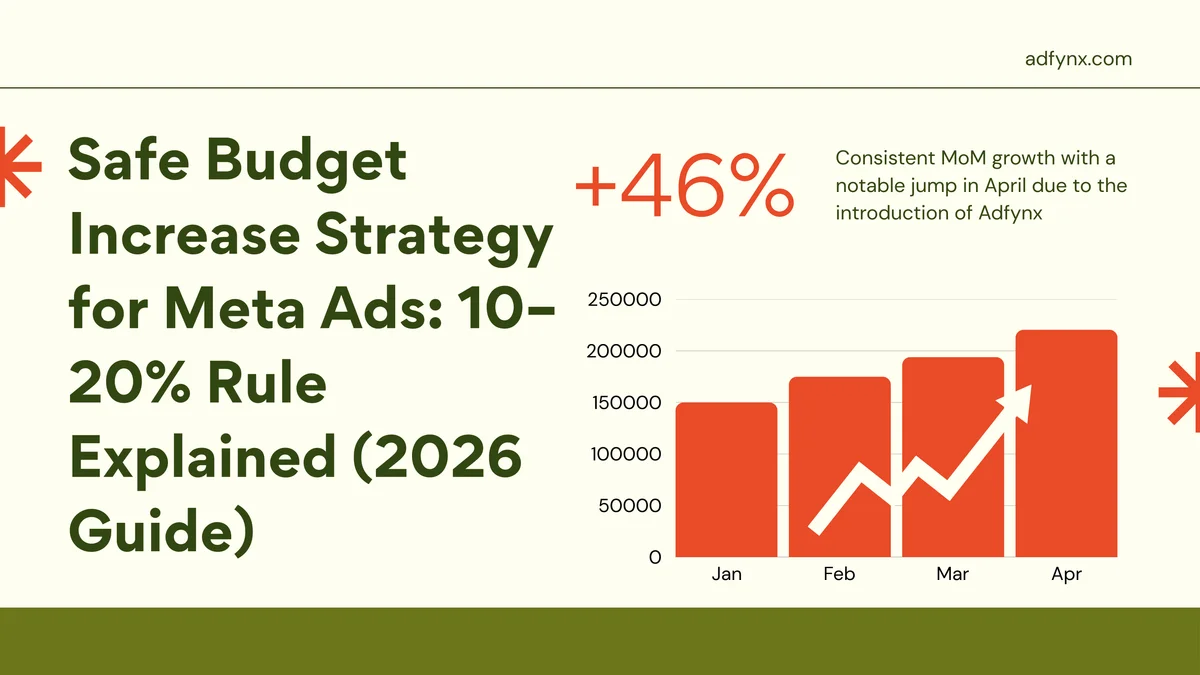
Safe Budget Increase Strategy for Meta Ads: 10–20% Rule Explained (2026 Guide)
Master safe Meta ads budget scaling with the proven 10-20% daily increase rule. Learn optimal timing (target region midnight), threshold limits (20% safe, 30-50% aggressive, >50% triggers learning reset), vertical vs horizontal scaling approaches, and when to break the rule for breakthrough scaling with broad targeting strategies.

Budget Up, Orders Flat, ROAS Down? You've Hit Meta's 'Daily Cycle Trap'
Increased budget but sales won't budge? Changed creatives but stuck at the same order volume? You're not doing anything wrong—Meta's algorithm has locked your account into a 'safe zone' and refuses to scale. Learn the 3 signals that prove you're trapped and the 2 verification methods to confirm your ceiling.
Meta Ads Budget Distribution Explained: CBO vs ABO Strategy Guide for 2026
Master Meta ads budget distribution with the complete CBO vs ABO comparison. Learn when to use Campaign Budget Optimization (algorithmic distribution, 3-4 ad sets for small budgets, 7-10 for large) vs Ad Set Budget Optimization (manual control, testing scenarios), optimal ad set quantities by budget level, and why the 20% scaling rule is obsolete in 2026's AI-driven algorithm.
Subscribe to Our Newsletter
Get weekly AI-powered Meta Ads insights and actionable tips
We respect your privacy. Unsubscribe at any time.