
Meta Ads Budget Distribution Explained: CBO vs ABO Strategy Guide for 2026
Master Meta ads budget distribution with the complete CBO vs ABO comparison. Learn when to use Campaign Budget Optimization (algorithmic distribution, 3-4 ad sets for small budgets, 7-10 for large) vs Ad Set Budget Optimization (manual control, testing scenarios), optimal ad set quantities by budget level, and why the 20% scaling rule is obsolete in 2026's AI-driven algorithm.
# Meta Ads Budget Distribution Explained: CBO vs ABO Strategy Guide for 2026
Meta advertisers face a fundamental structural decision that determines campaign scalability and optimization efficiency: Campaign Budget Optimization (CBO) versus Ad Set Budget Optimization (ABO). This choice controls whether Meta's algorithm or manual advertiser input distributes budget across ad sets, directly impacting learning phase completion speed, scaling potential, and overall account performance.
CBO delegates budget allocation to Meta's algorithmic system, which analyzes real-time conversion signals, audience behavior patterns, and auction dynamics to automatically distribute spend toward highest-performing ad sets. ABO maintains manual budget control at the ad set level, requiring advertisers to set individual budgets and adjust allocation based on performance analysis. Understanding when each approach optimizes for specific campaign objectives, budget levels, and account maturity stages is critical for maximizing return on ad spend in 2026's AI-driven advertising environment.
This guide explains the technical differences between CBO and ABO, provides optimal ad set quantity frameworks for different budget levels, details why traditional 20% scaling rules no longer apply, and outlines strategic implementation approaches for both small-budget testing scenarios and large-budget scaling operations.
What Is CBO (Campaign Budget Optimization) and How Does It Work?
Campaign Budget Optimization is Meta's algorithmic budget distribution system that allocates daily or lifetime campaign budgets across multiple ad sets based on real-time performance signals and predicted conversion probability.
Core mechanism: When you set a campaign budget of $300/day with CBO enabled, Meta's algorithm continuously evaluates each ad set's performance metrics (conversion rate, cost per result, auction competitiveness) and dynamically shifts budget toward ad sets demonstrating highest efficiency. This allocation adjusts throughout the day as performance patterns change.
Algorithmic advantages:
1. Real-time optimization: System processes millions of data points per second to identify optimal budget allocation
2. Auction timing intelligence: Algorithm recognizes high-conversion time windows and increases spend during peak performance periods
3. Automatic reallocation: Budget shifts away from underperforming ad sets without manual intervention
4. Faster learning phase: Concentrated budget on winning ad sets accelerates the 50-event learning threshold
Technical operation: CBO uses predictive modeling to forecast which ad sets will generate conversions most efficiently in the next auction opportunity. Budget flows to ad sets with highest predicted conversion probability, creating dynamic allocation that changes hourly based on audience availability and competitive landscape.
When CBO excels:
- Scaling proven campaigns with multiple audience segments
- Large daily budgets ($200+/day) supporting 5+ ad sets
- Accounts with stable conversion tracking and sufficient historical data
- Situations requiring minimal manual optimization time
What Is ABO (Ad Set Budget Optimization) and When to Use It?
Ad Set Budget Optimization maintains manual budget control at the individual ad set level, requiring advertisers to set specific daily or lifetime budgets for each ad set within a campaign.
Core mechanism: With ABO, you manually allocate budget across ad sets (e.g., Ad Set A: $50/day, Ad Set B: $75/day, Ad Set C: $100/day). Each ad set operates independently with its own learning phase and budget constraints, providing precise control over spend distribution.
Manual control advantages:
1. Precise budget allocation: Guarantee specific spend levels for priority audiences or testing scenarios
2. Learning phase management: Control which ad sets receive sufficient budget to exit learning phase
3. Risk mitigation: Limit exposure on unproven audiences or creative variations
4. Testing isolation: Ensure equal budget distribution for valid A/B testing
When ABO excels:
- Initial campaign testing with unproven audiences or creative
- Small daily budgets (<$100/day) where CBO budget distribution may be erratic
- Scenarios requiring guaranteed minimum spend on specific audiences (e.g., remarketing)
- A/B testing situations demanding equal budget allocation for statistical validity
- Accounts with inconsistent conversion tracking or pixel implementation issues
Strategic limitation: ABO requires continuous manual monitoring and budget reallocation based on performance analysis. As campaigns scale, manual optimization becomes time-intensive and less efficient than algorithmic distribution.
CBO vs ABO: Direct Performance Comparison
The fundamental difference between CBO and ABO lies in decision-making authority and optimization speed.
Budget allocation speed:
- CBO: Real-time reallocation (hourly adjustments based on performance)
- ABO: Manual reallocation (daily or weekly adjustments based on advertiser analysis)
Learning phase efficiency:
- CBO: Faster completion (budget concentrates on winning ad sets, accelerating 50-event threshold)
- ABO: Slower completion (budget spreads evenly, delaying learning phase exit for all ad sets)
Scaling capability:
- CBO: Superior scaling (algorithm handles increased budget distribution automatically)
- ABO: Manual scaling (requires proportional budget increases across multiple ad sets)
Optimization workload:
- CBO: Low manual effort (algorithm manages distribution)
- ABO: High manual effort (requires continuous performance monitoring and reallocation)
Performance predictability:
- CBO: Variable daily performance (algorithm tests different allocations)
- ABO: Stable daily performance (fixed budget allocation)
Optimal use case summary:
| Scenario | Recommended Approach | Rationale |
|---|---|---|
| Testing new audiences/creative | ABO | Controlled budget exposure, equal testing conditions |
| Scaling proven campaigns | CBO | Algorithmic efficiency, reduced manual workload |
| Small budgets (<$100/day) | ABO | Prevents erratic CBO distribution with limited budget |
| Large budgets ($300+/day) | CBO | Algorithm excels with sufficient budget for optimization |
| Remarketing campaigns | ABO | Guaranteed budget allocation to high-value audiences |
| Prospecting campaigns | CBO | Algorithmic audience discovery and optimization |
Conclusion: CBO optimizes for efficiency and scale through algorithmic intelligence, while ABO optimizes for control and precision through manual allocation. Most mature accounts benefit from hybrid approach: ABO for testing, CBO for scaling.
Optimal Ad Set Quantity by Budget Level for CBO Campaigns
CBO performance directly correlates with the relationship between total campaign budget and number of active ad sets. Insufficient budget per ad set prevents learning phase completion; excessive ad sets fragment budget and delay optimization.
Budget-to-ad-set framework:
Small Budget ($100-$200/day): 3-4 Ad Sets Maximum
Calculation logic: If your average CPA is $30, a $100 daily budget supports approximately 3 conversions. Distributing this across 3-4 ad sets provides each with sufficient budget ($25-$33 per ad set) to generate conversion signals.
Implementation:
- Campaign budget: $100/day
- Ad sets: 3-4 maximum
- Expected allocation per ad set: $25-$35/day
- Conversions per ad set: 0.8-1.2 daily (sufficient for learning progression)
Strategic approach:
- Focus on highest-confidence audiences (1-3% LAL, core interest groups)
- Limit creative variations to 2-3 per ad set
- Monitor which ad set becomes "dominant" (receives 50%+ of budget)
- Consolidate budget toward winning ad set after 5-7 days
Critical mistake: Launching 10+ ad sets with $100/day budget fragments allocation to $10 per ad set, preventing any ad set from generating sufficient conversions for learning phase completion.
Medium Budget ($200-$400/day): 6-8 Ad Sets
Calculation logic: $300 daily budget with $30 CPA supports 10 conversions. Distributing across 6-8 ad sets provides $37-$50 per ad set, enabling 1-2 daily conversions per ad set for stable learning.
Implementation:
- Campaign budget: $300/day
- Ad sets: 6-8 recommended
- Expected allocation per ad set: $35-$50/day
- Conversions per ad set: 1-1.7 daily (stable learning phase progression)
Strategic approach:
- Expand audience diversity (multiple LAL percentages, interest combinations)
- Test 3-5 creative variations per ad set
- Allow algorithm 7-10 days to establish allocation patterns
- Expect 2-3 ad sets to dominate budget distribution (60-70% of total spend)
Large Budget ($500+/day): 10+ Ad Sets
Calculation logic: $500+ daily budgets provide algorithm with sufficient resources to test multiple audience segments simultaneously while maintaining adequate budget per ad set ($50+) for rapid learning.
Implementation:
- Campaign budget: $500+/day
- Ad sets: 10-15 recommended
- Expected allocation per ad set: $50-$100/day (for active ad sets)
- Conversions per ad set: 1.5-3+ daily (rapid learning phase completion)
Strategic approach:
- Maximize audience diversity (broad targeting, multiple LAL tiers, interest crossovers)
- Launch with 10-15 ad sets, expect algorithm to concentrate budget on 3-5 winners
- Monitor for ad sets receiving <$20/day after 5 days (candidates for pause)
- Scale winning ad sets through campaign budget increases rather than ad set additions
Budget distribution reality: With large budgets, CBO typically concentrates 70-80% of spend on top 3-4 performing ad sets while maintaining minimal spend on remaining ad sets for continuous testing.
Recommended ad set quantities by budget:
| Daily Budget | Recommended Ad Sets | Budget Per Ad Set | Expected Daily Conversions Per Ad Set (CPA $30) |
|---|---|---|---|
| $100 | 3-4 | $25-$33 | 0.8-1.1 |
| $200 | 5-6 | $33-$40 | 1.1-1.3 |
| $300 | 6-8 | $37-$50 | 1.2-1.7 |
| $500 | 10-12 | $42-$50 | 1.4-1.7 |
| $1,000+ | 12-15 | $67-$83 | 2.2-2.8 |
Critical principle: Budget per ad set must support minimum 0.8-1.0 daily conversions to maintain learning phase progression. Fragmenting budget below this threshold prevents optimization regardless of total campaign budget.
Why the 20% Daily Scaling Rule Is Obsolete in 2026
The traditional "increase budget by 20% daily" scaling methodology was designed for earlier Facebook algorithm versions that triggered learning phase resets with budget changes exceeding specific thresholds. Meta's current Advantage+ algorithm operates differently, making percentage-based scaling rules inefficient and often counterproductive.
Why 20% scaling no longer works:
1. Continuous Learning Phase Interruption
Increasing budget by 20% daily creates perpetual learning phase instability. While 20% increases theoretically avoid "significant edit" classification, daily modifications prevent the algorithm from establishing stable performance baselines.
Impact: Campaigns remain in continuous optimization mode without reaching performance stability, causing 15-25% higher CPA than campaigns allowed to stabilize for 7-14 days before scaling.
2. Ignores Market Condition Variability
Daily CPM fluctuations of 20-40% are common due to auction competition, seasonal factors, and audience availability. A fixed 20% budget increase may be insufficient to maintain conversion volume during high-CPM periods or excessive during low-CPM windows.
Example scenario:
- Day 1: $100 budget, $20 CPM, 5,000 impressions, 3 conversions
- Day 2: Increase to $120 (+20%), but CPM rises to $26 (+30%)
- Result: Only 4,615 impressions (7.7% decrease), 2 conversions (33% decrease)
The 20% budget increase failed to compensate for 30% CPM increase, resulting in performance decline despite "following the rule."
3. Disconnected from Actual Performance Metrics
Percentage-based scaling ignores the fundamental question: "What budget level supports my target conversion volume at current CPA?"
Performance-based scaling logic:
- Current: $100/day, $30 CPA, 3.3 conversions/day
- Goal: 5 conversions/day
- Required budget: $150/day (50% increase, not 20%)
Adhering to 20% rule would require multiple days to reach optimal budget level, delaying scaling and losing conversion opportunities.
The Modern Scaling Approach: CPA-Based Budget Allocation
Replace percentage-based scaling with performance-metric-driven budget allocation that responds to actual cost per acquisition and ROAS targets.
CPA-based scaling framework:
Step 1: Establish baseline performance
- Run campaign at initial budget for 7-10 days
- Calculate stable CPA (average over final 5 days)
- Verify ROAS meets or exceeds target threshold
Step 2: Define conversion volume target
- Determine desired daily conversion quantity
- Calculate required budget: Target Conversions × Current CPA
Step 3: Implement budget increase
- Increase budget to calculated level in single adjustment
- Allow 5-7 days for performance stabilization
- Monitor CPA and ROAS trends
Example implementation:
Baseline metrics:
- Current budget: $100/day
- Stable CPA: $28
- Current conversions: 3.6/day
- Current ROAS: 3.8
Scaling objective:
- Target conversions: 6/day
- Required budget: 6 × $28 = $168/day
- Budget increase: 68% (not 20%)
Expected outcome:
- New budget: $168/day
- Expected CPA: $28-$32 (10-15% increase acceptable)
- Expected conversions: 5.2-6.0/day
- Expected ROAS: 3.2-3.6 (15-20% decline acceptable during scaling)
ROAS-based scaling triggers:
| Current ROAS | Scaling Action | Budget Increase Range |
|---|---|---|
| 4.0+ | Aggressive scaling | 40-60% increase |
| 3.0-3.9 | Moderate scaling | 25-40% increase |
| 2.5-2.9 | Conservative scaling | 15-25% increase |
| 2.0-2.4 | Maintain current budget | Monitor for improvement |
| <2.0 | Reduce budget or pause | Optimize before scaling |
Critical rule: Budget increases should align with conversion volume targets and current CPA, not arbitrary percentage thresholds. If achieving target conversion volume requires 50% budget increase, implement 50% increase rather than fragmenting across multiple 20% adjustments.
Adfynx's AI-Generated Reports automatically calculate optimal budget levels based on target conversion volumes and current CPA trends, eliminating manual calculations and providing data-driven scaling recommendations.
Small Budget CBO Strategy: Concentration and Discipline
Operating CBO campaigns with limited daily budgets ($100-$200/day) requires strict discipline in ad set quantity management and performance monitoring to prevent budget fragmentation.
Core principle: Budget = CPA × 3 to 4
This formula ensures sufficient budget to support 3-4 daily conversions distributed across 3-4 ad sets, providing each ad set with minimum viable budget for learning progression.
Implementation framework:
Phase 1: Launch configuration (Days 1-3)
- Calculate campaign budget: CPA × 3 (conservative) or CPA × 4 (moderate)
- Create 3-4 ad sets with highest-confidence audiences
- Launch with 2-3 creative variations per ad set
- Monitor budget distribution patterns
Phase 2: Dominant ad set identification (Days 4-7)
- Identify which ad set receives majority of budget (typically 40-60%)
- Analyze performance metrics (CPA, ROAS, conversion rate) for dominant ad set
- Evaluate underperforming ad sets receiving <15% of budget
Phase 3: Consolidation (Days 8-14)
- Pause ad sets with CPA >150% of target or receiving <10% budget allocation
- Maintain 2-3 performing ad sets
- Allow algorithm to concentrate budget on proven winners
Example scenario:
Campaign setup:
- Target CPA: $30
- Campaign budget: $120/day (CPA × 4)
- Ad sets: 4 (Audience A, B, C, D)
Day 1-3 performance:
- Ad Set A: $45 spend, 2 conversions, $22.50 CPA
- Ad Set B: $38 spend, 1 conversion, $38 CPA
- Ad Set C: $25 spend, 0 conversions
- Ad Set D: $12 spend, 0 conversions
Day 4-7 optimization:
- Pause Ad Set C and D (insufficient budget allocation, no conversions)
- Maintain Ad Set A and B
- New distribution: Ad Set A receives $75-$85/day, Ad Set B receives $35-$45/day
Day 8+ stabilization:
- Ad Set A: 2.5-3 conversions/day, $25-$28 CPA
- Ad Set B: 1-1.5 conversions/day, $30-$35 CPA
- Combined performance: 3.5-4.5 conversions/day, $26-$30 blended CPA
Critical mistakes to avoid:
1. Launching 10+ ad sets with $100/day budget: Fragments allocation to $10 per ad set, preventing learning
2. Equal budget distribution expectation: CBO will not distribute evenly—expect 70-80% concentration on 1-2 ad sets
3. Premature ad set pausing: Allow 5-7 days before pausing underperforming ad sets
4. Ignoring creative quality: With limited budget, creative performance determines success more than audience targeting
Large Budget CBO Strategy: Patience and Data-Driven Pruning
Large daily budgets ($500-$1,000+/day) enable CBO's full algorithmic potential through extensive audience testing and rapid learning phase completion, but require patience during initial optimization periods.
Core principle: Launch with 7-10 ad sets, expect algorithm to concentrate budget on 3-4 winners within 7-14 days.
Implementation framework:
Phase 1: Broad launch (Days 1-3)
- Create 7-10 ad sets with diverse audience segments
- Set campaign budget: $500-$1,000+/day
- Include proven performers (1-3% LAL) and expansion audiences (5-10% LAL, broad targeting)
- Launch with 3-5 creative variations per ad set
Phase 2: Initial distribution observation (Days 1-5)
- Monitor budget allocation patterns
- Expect erratic distribution as algorithm tests different ad sets
- Anticipate elevated CPA (potentially 2-3x target) during initial learning
- Resist urge to pause ad sets receiving low budget allocation
Example Day 1-3 scenario:
Campaign: $500/day budget, 7 ad sets, target CPA $30
Actual performance:
- Total spend: $500
- Conversions: 4 (blended CPA: $125)
- Distribution: Ad Set A ($180, 2 conversions), Ad Set B ($140, 2 conversions), Ad Sets C-G ($180 combined, 0 conversions)
Common panic response (incorrect): "CPA is $125, campaign is failing, pause immediately"
Correct response: "Algorithm is testing, allow 5-7 days for optimization before evaluation"
Phase 3: Performance stabilization (Days 4-10)
- Observe CPA trend (should decline daily as algorithm optimizes)
- Identify ad sets consistently receiving budget and generating conversions
- Monitor for ad sets receiving <$30/day after Day 5 (candidates for pause)
Phase 4: Strategic pruning (Days 7-14)
- Pause ad sets with CPA >200% of target after 7+ days
- Pause ad sets receiving <5% of budget allocation
- Maintain 3-5 performing ad sets
- Expected outcome: 2-3 ad sets receive 70-80% of budget, achieve target CPA
Example Week 2 stabilization:
Campaign performance:
- Total spend: $500/day
- Conversions: 14-16/day
- Blended CPA: $31-$36
- Active ad sets: 4 (pruned 3 underperformers)
- Distribution: Ad Set A (40% budget), Ad Set B (30% budget), Ad Sets C-D (30% combined)
Critical patience requirement: Large budget CBO campaigns often show concerning metrics in Days 1-5 (elevated CPA, low conversion volume) before stabilizing in Days 7-14. Premature optimization prevents algorithm from completing learning phase and identifying optimal budget allocation.
Adfynx's Multi-Account Dashboard enables simultaneous monitoring of CBO budget distribution across multiple campaigns, identifying underperforming ad sets consuming disproportionate budget and providing pruning recommendations based on performance thresholds.
Transitioning from ABO to CBO: Strategic Migration Framework
Accounts typically begin with ABO for testing, then transition to CBO for scaling. Proper migration timing and execution preserve performance while unlocking algorithmic optimization benefits.
Transition readiness criteria:
1. Conversion volume threshold: Minimum 50 conversions accumulated in ABO campaign
2. Stable performance: CPA variance <20% over 7-day period
3. Identified winners: 2-3 ad sets demonstrating consistent performance
4. Sufficient budget: Daily budget supports 3+ conversions at current CPA
Migration methodology:
Option 1: Duplicate and transition (recommended)
- Maintain existing ABO campaign unchanged
- Create new CBO campaign with identical ad sets
- Set CBO budget equal to combined ABO ad set budgets
- Run both campaigns for 7 days
- Evaluate CBO performance; pause ABO if CBO achieves 80%+ of ABO efficiency
Option 2: Direct conversion
- Convert existing ABO campaign to CBO through campaign settings
- Warning: Triggers learning phase reset for all ad sets
- Only use if willing to accept 5-7 day performance disruption
Post-transition optimization:
Days 1-7: Monitor CBO budget distribution and performance trends
Days 8-14: Prune underperforming ad sets based on allocation and CPA
Days 15+: Scale CBO budget using CPA-based methodology
Expected performance impact:
- Initial (Days 1-7): CPA increase of 20-40% during learning phase
- Stabilization (Days 8-14): CPA returns to within 10-15% of ABO baseline
- Optimization (Days 15+): CBO typically achieves 5-15% better efficiency than ABO due to algorithmic optimization
Common CBO Mistakes That Destroy Performance
Five strategic errors consistently undermine CBO campaign effectiveness and prevent algorithmic optimization.
1. Excessive Ad Set Quantity for Budget Level
Launching 15+ ad sets with $200/day budget fragments allocation below minimum viable threshold, preventing any ad set from completing learning phase.
Consequence: All ad sets remain in perpetual learning with elevated CPA and unstable performance.
Solution: Limit ad sets to budget-appropriate quantity (3-4 for $100/day, 6-8 for $300/day, 10+ for $500+/day).
2. Frequent Budget Modifications
Adjusting campaign budget every 1-2 days creates continuous learning phase interruption and prevents performance stabilization.
Consequence: CPA remains 20-30% higher than campaigns allowed to stabilize for 7-14 days between adjustments.
Solution: Implement budget changes maximum once per week; allow 7-10 days for stabilization before subsequent adjustments.
3. Premature Ad Set Pausing
Pausing ad sets receiving low budget allocation within first 3-5 days prevents algorithm from completing initial testing phase.
Consequence: Eliminates potentially high-performing ad sets before algorithm identifies optimization opportunities.
Solution: Allow minimum 7 days before pausing ad sets; evaluate based on CPA and allocation patterns, not allocation alone.
4. Equal Budget Distribution Expectation
Expecting CBO to distribute budget evenly across all ad sets contradicts algorithmic optimization purpose.
Consequence: Frustration with "uneven" distribution that is actually optimal algorithmic behavior.
Solution: Accept that CBO will concentrate 70-80% of budget on top 2-3 ad sets; this is intended functionality, not malfunction.
5. Ignoring Creative Quality in CBO Campaigns
Launching CBO with weak creative assets and expecting algorithmic optimization to compensate for poor engagement metrics.
Consequence: Algorithm has no high-performing ad sets to allocate budget toward, resulting in poor overall campaign performance.
Solution: Ensure creative assets demonstrate strong engagement (CTR 2%+, video completion 40%+) before implementing CBO; algorithm amplifies creative quality, doesn't create it.
Measuring CBO Success: Key Performance Indicators
Track five critical metrics to evaluate CBO campaign effectiveness and identify optimization opportunities.
1. Budget distribution concentration
- Metric: Percentage of budget allocated to top 3 ad sets
- Target: 60-80% concentration on top performers
- Warning sign: Even distribution (20-30% per ad set) indicates algorithm hasn't identified winners
2. Learning phase status
- Metric: Number of ad sets in "Learning" vs "Active" status
- Target: 50%+ of ad sets exit learning phase within 7-14 days
- Warning sign: All ad sets remain in learning after 14+ days (insufficient budget per ad set)
3. CPA stability trend
- Metric: Daily CPA variance over 7-day periods
- Target: CPA variance <15% after initial 14-day optimization period
- Warning sign: CPA variance >25% indicates unstable performance requiring investigation
4. Ad set pruning rate
- Metric: Percentage of launched ad sets paused due to underperformance
- Target: 30-50% of ad sets pruned within 14 days (normal optimization)
- Warning sign: 0% pruning (insufficient optimization) or 80%+ pruning (poor audience/creative selection)
5. Scaling efficiency
- Metric: CPA increase percentage when scaling budget 2-3x
- Target: CPA increase <20% when doubling budget
- Warning sign: CPA increase >30% indicates scaling too aggressive or insufficient audience expansion
Frequently Asked Questions
Q: Should I use CBO or ABO for Meta ads in 2026?
A: Use ABO for initial testing of new audiences, creative variations, or campaigns with small budgets (<$100/day) where you need precise budget control. Transition to CBO once you've identified 2-3 winning ad sets, accumulated 50+ conversions, and have daily budget of $150+/day. CBO excels at scaling proven campaigns through algorithmic optimization, while ABO provides control during testing phases. Most mature accounts benefit from hybrid approach: ABO for testing, CBO for scaling.
Q: How many ad sets should I have in a CBO campaign?
A: Ad set quantity depends on daily budget and target CPA. Use this framework: divide daily budget by (CPA × 0.8) to determine maximum ad sets. For $100/day budget with $30 CPA, maximum is 4 ad sets. For $300/day, 6-8 ad sets. For $500+/day, 10-15 ad sets. Exceeding these quantities fragments budget below minimum viable threshold ($25-30 per ad set), preventing learning phase completion and causing elevated CPA.
Q: Why does CBO give most budget to one ad set instead of distributing evenly?
A: Budget concentration on 1-2 ad sets is intended CBO functionality, not malfunction. The algorithm identifies which ad sets generate conversions most efficiently and allocates budget accordingly to maximize overall campaign performance. Expect 60-80% of budget to flow to top 2-3 performing ad sets while remaining ad sets receive minimal spend for continuous testing. This concentration enables faster learning phase completion and better overall ROAS than even distribution.
Q: How long should I wait before pausing underperforming ad sets in CBO campaigns?
A: Allow minimum 7 days before pausing ad sets in CBO campaigns. The algorithm requires 5-7 days to complete initial testing and establish budget allocation patterns. Pause ad sets after 7+ days if they meet two criteria: (1) receiving <5% of total budget allocation, and (2) CPA >200% of target. Ad sets receiving low budget but achieving target CPA should be maintained as backup options if primary ad sets fatigue.
Q: Can I increase CBO budget by more than 20% per day without resetting learning phase?
A: Yes—the 20% daily scaling rule is obsolete in 2026. Meta's current algorithm tolerates larger budget increases (30-50%+) without triggering learning phase reset, especially for campaigns with 50+ accumulated conversions. Scale based on performance metrics (CPA and ROAS) rather than arbitrary percentages. If current CPA is $30 and you want 6 conversions/day instead of 3, increase budget by 100% ($100 to $200) rather than fragmenting across multiple 20% increases. Allow 5-7 days for stabilization after each increase.
Conclusion: Algorithmic Optimization Requires Strategic Framework
CBO represents Meta's shift toward algorithmic budget optimization that outperforms manual allocation when implemented within proper strategic frameworks. The system excels at identifying high-performing ad sets and concentrating budget for maximum efficiency, but requires advertisers to provide sufficient budget per ad set, appropriate ad set quantities, and patience during learning phases.
Success with CBO in 2026 demands abandoning outdated percentage-based scaling rules in favor of performance-metric-driven budget allocation based on CPA and ROAS targets. Small budgets require disciplined ad set limitation (3-4 maximum) and rapid consolidation toward winners. Large budgets enable extensive testing (7-10+ ad sets) but demand patience during initial optimization periods where CPA may appear concerning before stabilizing.
The optimal approach combines ABO for controlled testing of new audiences and creative with CBO for scaling proven campaigns through algorithmic intelligence. This hybrid methodology leverages manual precision during high-risk testing phases and algorithmic efficiency during low-risk scaling phases, maximizing overall account performance across the campaign lifecycle.
You May Also Like
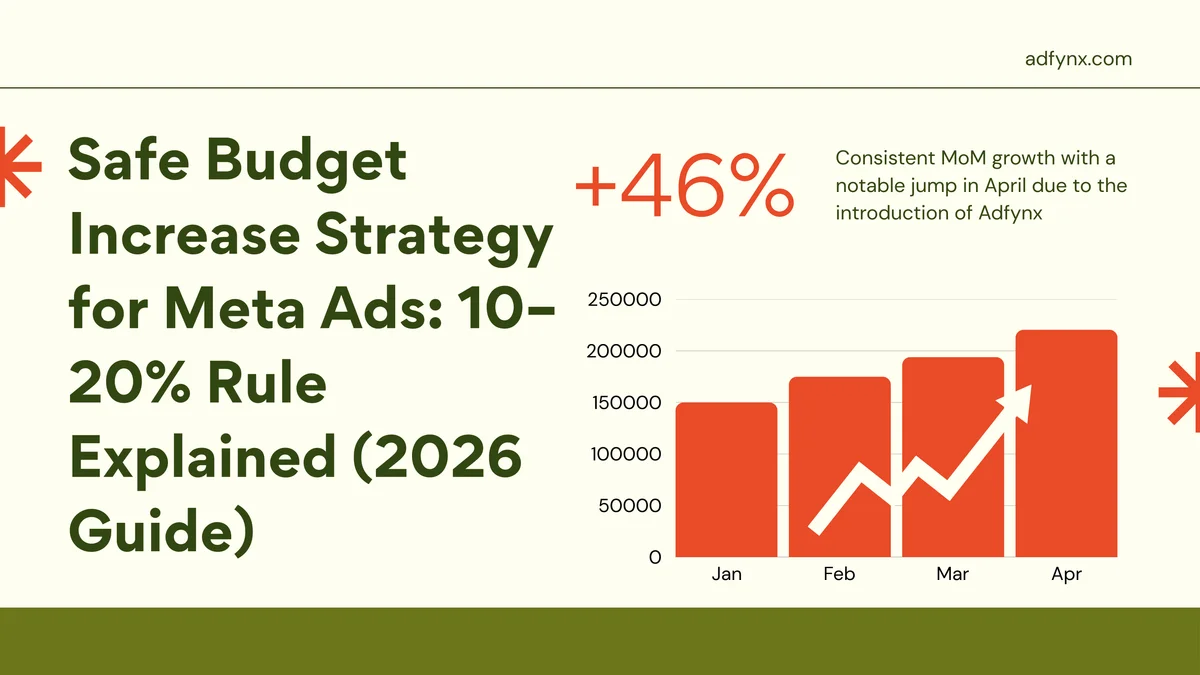
Safe Budget Increase Strategy for Meta Ads: 10–20% Rule Explained (2026 Guide)
Master safe Meta ads budget scaling with the proven 10-20% daily increase rule. Learn optimal timing (target region midnight), threshold limits (20% safe, 30-50% aggressive, >50% triggers learning reset), vertical vs horizontal scaling approaches, and when to break the rule for breakthrough scaling with broad targeting strategies.
2026 Facebook Ads Scaling Logic You Must Master: The Four-Campaign Method That Prevents Budget Increases from Killing ROAS
Stop watching your CPA spike and ROAS crash when you increase budget. Learn the proven four-campaign method that lets Meta's algorithm scale profitably with sufficient creative supply and stable data.
From $500 to $50,000/Day: Complete Facebook Ads Structure & Pro Account Architecture Guide
Master the 3-layer Facebook Ads physics and four-stage scaling SOP. Learn modular structures (1-1-1, 1-4-1, 1-4-4) and budget rules to scale from hundreds to $50k/day without killing ROAS.
Subscribe to Our Newsletter
Get weekly AI-powered Meta Ads insights and actionable tips
We respect your privacy. Unsubscribe at any time.