
Facebook Ads: Manual Audience vs Advantage+ Audience | The Andromeda Era Decision Guide
After 3-5 years running ads, most media buyers still can't explain the real difference between Manual and A+ Audiences. Learn when to use each, how they work under Andromeda, and why your scaling strategy depends on understanding both.
TL;DR: Many media buyers with 3-5 years of experience still can't clearly explain the difference between Manual Audience (including Broad) and Advantage+ Audience (A+). The confusion gets worse when deciding between campaign structures like 1-1-1, 1-3-3, or 1-n-n. But here's the truth: structure matters less than understanding how each audience type learns. Manual Audience = real-time signal learning with unlimited upside but volatile early performance. A+ Audience = historical model-based learning with stable cold starts but limited scaling ceiling. Post-Andromeda, the difference is critical: A+ gets you stable, Manual gets you scale. Use A+ for cold starts and stability; use Manual for exploration and breakthrough scaling. The best operators run both in parallel.
---The Question Every Media Buyer Asks (But Few Can Answer)
I've consulted with hundreds of advertisers, and the most common question I hear is:
"Should I use 1-1-1, 1-3-3, or 1-n-n structure? And should I use Manual or A+ Audience?"
My response is always the same:
"You're asking about campaign structure before understanding how audiences actually work. That's like asking which car to buy before learning how to drive."
Here's what really matters: Understanding the fundamental learning mechanisms of Manual Audience vs Advantage+ Audience. Once you grasp this, campaign structure becomes a tactical choice, not a strategic dilemma.
Since Meta's Andromeda algorithm launched, this distinction has become even more critical. Andromeda is Meta's unified modeling system—it's not an audience strategy itself, but it dramatically amplifies how each audience type performs. It affects signal utilization efficiency and optimization pathways.
Let me break down the real difference using two vivid metaphors that will make everything crystal clear.
---Manual Audience = The Genius Wild Horse (Andromeda Era)
Manual Audience is what most people call "original audience" or "manual targeting." But I prefer calling it Manual Audience because it's more accurate:
- You define the audience boundaries (interests, demographics, behaviors, or Broad)
- Broad targeting is just one way to use Manual Audience—it's not a separate category
- The algorithm learns in real-time from live signals: clicks, engagement, dwell time, add-to-cart, checkout, conversions
Characteristics After Andromeda
With Andromeda's launch, this "genius wild horse" has been unleashed to its full potential:
✅ Strengths:
- Unlimited upside — when it finds the right path, scaling can be explosive
- Real-time learning — adapts to live user behavior signals
- Exploration power — discovers new audience segments you never knew existed
- Strongest scaling potential — can break through plateaus that A+ can't
❌ Weaknesses:
- Chaotic early phase — burns budget while learning
- High volatility — performance swings wildly in the first 3-7 days
- Requires patience — needs time and budget to "feed the algorithm"
- More failures than wins — most Manual campaigns don't explode (but the ones that do make it worth it)
The Wild Horse Metaphor
Think of Manual Audience as a genius wild horse running free on the open plains:
- You don't train it—it learns on its own
- You give it good creative (grass) and stable budget (stamina)
- It runs in random directions at first, testing different paths
- Most of the time it doesn't find the optimal route
- But when it does, it suddenly awakens and sprints at full speed
The creative is the grass. The budget is the stamina. If you feed the algorithm well, it will eventually have a breakthrough moment and start running in the right direction—fast.
---Advantage+ Audience (A+) = The Well-Trained Honor Student (Andromeda Era)
Advantage+ Audience (A+) is Meta's latest audience type that:
- Automatically expands audience boundaries
- Automatically merges interests and behaviors
- Automatically applies lookalike modeling
- Automatically optimizes based on historical account data
- Relies on historical learning and account modeling
Characteristics After Andromeda
A+ is the "well-trained honor student"—it follows the proven path:
✅ Strengths:
- Immediate results — performs well from day one
- Cold-start friendly — ideal for new accounts, new products, new pixels
- Stable and predictable — less volatility, easier to forecast
- Lower risk — rarely crashes and burns
❌ Weaknesses:
- Limited ceiling — can't break through to new audience territories as easily
- Slower scaling — expansion is more gradual than Manual
- Data fatigue — performance degrades over time as it exhausts the historical model
- Follows old paths — relies on what worked before, not what could work next
The Honor Student Metaphor
Think of A+ as a well-trained honor student:
- Good upbringing (historical data)
- Obedient and reliable
- Runs steadily on the proven track
- But it only runs the routes others have run before
It's fast, stable, and safe—but it will never discover a completely new path. It optimizes within known boundaries.
---The Andromeda Era: How the Differences Got Amplified
Andromeda is Meta's unified modeling system—not an audience strategy. It's the engine that powers both Manual and A+ Audiences. But here's what changed:
What Andromeda Does
- Improves signal utilization efficiency — extracts more value from every click, view, and conversion
- Accelerates optimization pathways — learns faster from real-time data
- Unifies cross-campaign learning — shares insights across your entire ad account
How It Affects Each Audience Type
| Audience Type | Learning Method | Advantage | Disadvantage | Best Use Case |
|---|---|---|---|---|
| Manual Audience | Real-time signals, self-learning | Unlimited ceiling, fastest scaling | High early volatility, burns budget | Scaling phase / Mature accounts |
| A+ Audience | Historical modeling | Fast cold start, stable performance | Slower scaling, data fatigue | Cold start / Stability phase |
One-sentence summary:
- A+ uses "what the system already knows"
- Manual uses "real-time learning"
A+ brings stability. Manual brings breakthroughs.
That's the entire logic.
---Practical Strategy: When to Use Each (Post-Andromeda)
This is what you actually need to take away.
① Cold Start Phase: A+ Audience First (Stability)
New product / New account / New pixel → A+ is critical.
Why? Because at this stage, the algorithm "knows nothing." A+'s historical model helps it quickly understand:
- Who might buy
- What they buy
- Why they buy
You're essentially giving the algorithm an "entry-level tutorial."
Recommended setup:
- Start with A+ Audience
- Budget: $50–$150/day
- Let it run for 3–7 days to gather baseline data
- Monitor: CTR, CPA, conversion rate
② Testing Phase: A+ + Manual in Parallel (Multi-Track Learning)
Once your creative starts generating signals, you must bring Manual Audience into the mix.
Why? Because Andromeda's learning logic is:
"Give me more freedom, and I'll learn faster."
A+ provides the stable baseline (protects your downside).
Manual provides the exploration (unlocks your upside).
You need both:
- A well-trained horse (protects the floor)
- A genius wild horse (chases the ceiling)
Your training system is only complete when you have both.
Recommended setup:
- Campaign 1: A+ Audience, $100/day
- Campaign 2: Manual Audience (Broad or interest-based), $100/day
- Run both for 5–7 days
- Compare: CPA, ROAS, scaling potential
③ Scaling Phase: Manual Audience = Primary Driver (Breakthrough)
In the scaling phase, you don't want stability—you want breakthrough.
Manual Audience offers:
- Largest audience pool
- Strongest learning capability
- Zero artificial restrictions
The more diverse your creative, the faster Manual learns.
This is the clearest consensus in the Andromeda era: Scaling depends on Manual Audience, not audience modeling.
Recommended setup:
- Primary campaigns: Manual Audience (Broad), $500–$2,000/day
- Supporting campaigns: A+ Audience, $200–$500/day (for stability)
- Creative strategy: Ship 3–5 new creatives per week
- Budget increases: +20–30% every 3–5 days (if CPA remains stable)
④ Mature Phase: Multi-Strategy Parallel (Fast + Stable)
The strongest combination at maturity:
- A+ Audience protects the downside (stable daily revenue)
- Manual Audience chases the upside (unlimited scaling potential)
You never know which horse will deliver the next breakthrough.
Recommended setup:
- A+ campaigns: 30–40% of budget (stability)
- Manual campaigns: 60–70% of budget (scaling)
- Creative rotation: Weekly refresh to prevent fatigue
- Monitoring: Use Adfynx's AI-powered analytics to track performance across both audience types in real-time
The Biggest Mistake Media Buyers Make
I always emphasize: Treat audiences as learning mechanisms, not as settings.
Many media buyers obsess over:
- "Should I use 1-1-1, 1-3-3, or 1-n-n?"
- "Which structure is best?"
But the real question is:
How do you want the algorithm to learn?
- A+ = textbook-style learning (follows proven paths)
- Manual = experiential learning (discovers new paths)
If you don't understand the learning logic, even the best campaign structure won't save you.
---Summary: The Decision Framework
Let me distill this into one sentence:
A+ Audience = Let the algorithm run "past success paths"
Manual Audience = Let the algorithm run "future possibilities"
- Want stability → A+
- Want breakthroughs → Manual
- Want sustainable growth → Run both
The Andromeda Era Truth: It's Not About Control, It's About Release
The essence of advertising has never been about control—it's about release.
Advertising isn't "letting it run wild"—it's "releasing it to the algorithm."
- In the early phase, you "teach the algorithm to run" using A+ to build a stable foundation
- But to truly win, you must "release the reins" and let Manual explore freely, allowing the algorithm to learn on its own
Post-Andromeda Strategy: Meta's Direction Is Clear
Since Andromeda launched, Meta's strategy has become increasingly obvious:
The system will get smarter and more "opinionated." It wants to make decisions for you, but you can't hand over the steering wheel completely.
That's why I always say:
"Trust the algorithm, but stay skeptical."
This isn't a contradiction—it's symbiosis.
- Trust the algorithm's computational power
- Question every "automated" decision it makes
- Learn to let it run freely
- But also know when to lightly tap the brakes
When You Understand the Algorithm's Logic
When you start understanding the algorithm's underlying logic, and learn to work with its tendencies while optimizing against its blind spots—
That's when you stop being just a media buyer.
You become a driver.
---Tracking Performance Across Both Audience Types
One of the biggest challenges when running A+ and Manual in parallel is tracking performance accurately across both audience types.
Common problems:
- Scattered data across multiple dashboards
- Can't quickly compare A+ vs Manual performance
- Miss critical signals when one audience type starts declining
- Waste time manually pulling reports
The solution: Use an AI-powered analytics tool that helps you understand your campaign performance through natural conversation and automated insights.
Try Adfynx for Free — AI Meta Ads Analyst that helps you:
- Ask questions in plain English — "Which campaigns are underperforming?" or "Show me my best-performing creatives"
- Get instant visual insights — Interactive charts and data breakdowns, not just raw numbers
- Analyze creative performance — See which images, videos, and copy variations drive actual conversions
- Generate professional reports — Auto-generated insights with scheduled delivery in 60 seconds
Stop spending hours digging through dashboards. Get your free AI audit and understand your Meta Ads performance in 60 seconds.
---Related Resources
Want to master Facebook Ads scaling? Check out our Complete Facebook Ads Account Structure Guide to learn the 1-1-1, 1-4-1, and 1-4-4 frameworks that work with both Manual and A+ Audiences.
Struggling with creative performance? Read our Fatal Mistakes in Facebook Ad Hooks to learn how to craft hooks that work for both audience types.
Want to understand Andromeda better? Dive into our Meta Andromeda Algorithm Deep Dive to learn how the unified modeling system actually works.
Need budget planning tools? Use our free Facebook Ads Cost Calculator to model your budget allocation between A+ and Manual campaigns.
Running Advantage+ Shopping Campaigns? Learn why they fail and how to fix them in our ASC Troubleshooting Guide.
---Final Thoughts: Believe in the Algorithm, Stay Skeptical
At the end of the day, advertising is not about control—it's about release.
You need to "release the algorithm to run," but not blindly.
- In the early phase, use A+ to "teach the child to run" and build a stable foundation
- But to truly win the race, you must dare to "release the reins" and let Manual run wild, allowing the algorithm to learn on its own
Since Andromeda, Meta's strategy has become clearer:
The system will get smarter and more "subjective." It wants to make decisions for you, but you can't completely hand over the steering wheel.
So I always say:
"Trust the algorithm, but stay skeptical."
This isn't a contradiction—it's symbiosis.
- Trust the algorithm's computational power
- Question every "automated" decision
- Learn to let it run freely
- But also know when to lightly tap the brakes
When you start understanding the algorithm's underlying logic, learning to work with its habits while optimizing against its blind spots—
That's when you stop being just a media buyer.
You become a driver.
You May Also Like
Why ROAS Drops When Scaling Meta Ads: 5 Root Causes and Proven Solutions for 2026
Discover why your Meta ads ROAS crashes from 3.0+ to under 1.0 when scaling budget, and learn the proven 3-part framework to scale profitably: gradual budget increases (10-20% increments), audience expansion strategies (LAL progression, broad targeting), and creative rotation systems that maintain performance at scale.
Why Facebook Manual Targeting Is Failing in 2026: The Free Space Era
If you're running Meta Ads in 2026, you've felt it: the more you target, the higher your CPM. The more you control, the worse it performs. Here's why manual targeting is being phased out and what 'Free Space' really means for your campaigns.
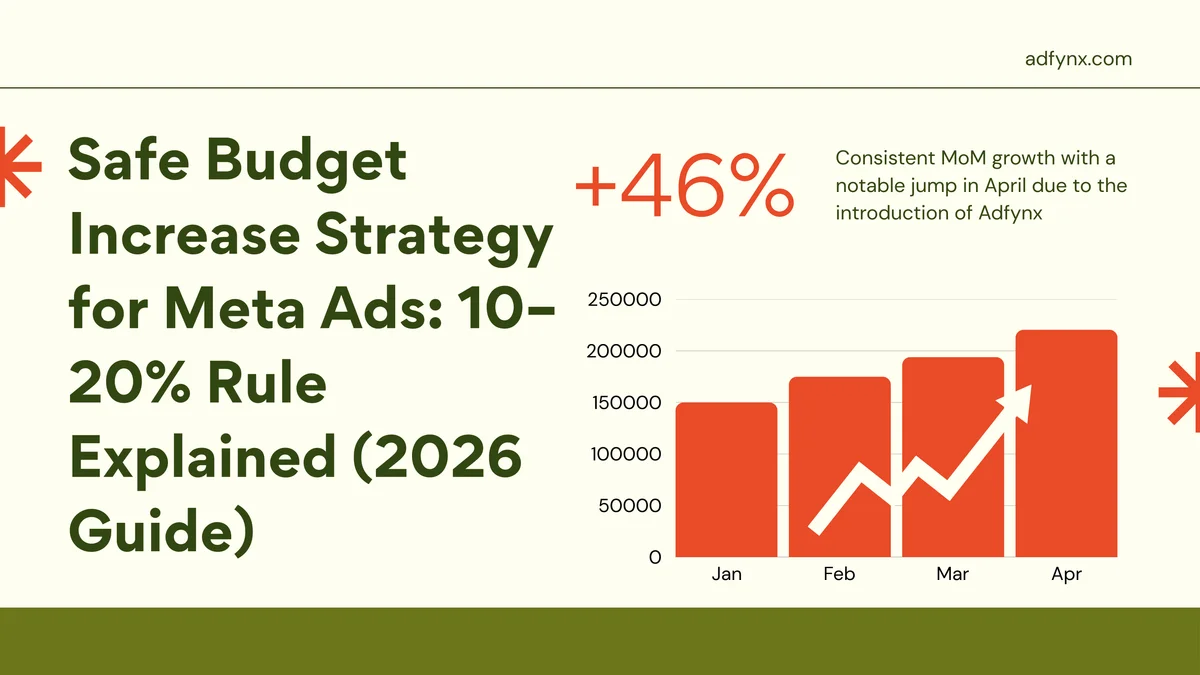
Safe Budget Increase Strategy for Meta Ads: 10–20% Rule Explained (2026 Guide)
Master safe Meta ads budget scaling with the proven 10-20% daily increase rule. Learn optimal timing (target region midnight), threshold limits (20% safe, 30-50% aggressive, >50% triggers learning reset), vertical vs horizontal scaling approaches, and when to break the rule for breakthrough scaling with broad targeting strategies.
Subscribe to Our Newsletter
Get weekly AI-powered Meta Ads insights and actionable tips
We respect your privacy. Unsubscribe at any time.